The Nasdaq Lost $2.5 Trillion in a Day as the AI Trade Met the Midterms
The Nasdaq fell 5.52% on 5 November 2026 and lost $2.5 trillion in market value as the midterm results prompted a repricing of the AI data center trade.

On this page
Key takeaways
- The Nasdaq Composite fell 5.52% to 24,315.00 on 5 November 2026, more than 10% below its record and in correction territory, while the S&P 500 fell 4.36% to 7,353.73.
- The iShares Semiconductor ETF fell about 12%, its worst day since March 2020, with Nvidia down 9%, Broadcom 10%, and AMD and Micron about 15% each.
- The Wall Street Journal put the Nasdaq's one-day market value loss at $2.5 trillion, a record, while CNBC had the Magnificent 7 down close to $900 billion heading into the final hour.
- Democrats won the House, the Senate and key governorships on 3 November 2026, and investors sold AI infrastructure stocks on fears of slower data center permitting and tighter regulation.
- No hyperscaler announced a cancelled data center on 5 November 2026, so the move was a repricing of political risk, not a confirmed cut to capital spending plans.
The Nasdaq Composite fell 5.52% to 24,315.00 on Thursday 5 November 2026, closing more than 10% below the record it set last month and into correction territory, as investors repriced the AI infrastructure trade around the midterm election result. The S&P 500 fell 4.36% to 7,353.73. The Dow Jones Industrial Average dropped 1,833.06 points, or 3.44%, to 51,523.06, and the Russell 2000 fell 4.45% into a correction of its own. All three major averages had their worst day since April 2025, according to CNBC's market wrap.
Related reading: Microsoft Borrows $25 Billion as the AI Buildout Moves Onto the Bond Market · Apple's Record Quarter Comes With a Memory Bill It Cannot Dodge.
The trigger was political. Democrats won the House and the Senate and took key governorships on 3 November 2026, and by Thursday investors had decided that a Democratic Congress and new state leaders could slow data center construction and tighten the rules around AI. CNBC reported that investors “accelerated their move away from technology stocks on fears of a data-center buildout slowdown.” No earnings shock explained the session. A market was changing the price it puts on a policy risk.
A correction in one session
All 11 S&P 500 sectors closed lower, and information technology was the worst at -6.6%, CNBC reported. The semiconductor complex did most of the damage:
- The iShares Semiconductor ETF (SOXX) fell about 12%, its worst day since March 2020, and every component closed down more than 6%. The fund was down 15% for the week.
- Broadcom fell 10%, Nvidia 9%, Oracle almost 7%, and Qualcomm 9% despite an earnings beat and a weak outlook.
- AMD and Micron fell about 15% each, Astera Labs 17%, MACOM 18% and Arm 12%.
- CoreWeave fell almost 10%, Nebius 15% and IREN almost 17%.
Stress showed up in volatility and chart levels. The VIX touched 28.09 intraday, its highest since 31 March, before trading around 26 later, CNBC reported. The Nasdaq closed below its 200-day moving average for the first time since April.
Two days, two directions
Wednesday had been the best session since April 2025. The Dow jumped more than 1,500 points after the decisive Democratic win, Trump's acceptance of the result and falling oil, CNBC reported. Thursday's 1,833-point fall more than wiped that gain out.
The same election produced a broad rally and a sector rout 24 hours apart. That is the first clue that the market was not simply voting on the result. It was separating the political outcome, which it read as settled, from the policy consequences for one specific trade.
The specific risk has a paper trail. Senator Bernie Sanders posted on X on Wednesday evening calling for a national data center moratorium, writing that “Americans don't want Big Tech oligarchs wrecking the environment, gutting jobs and threatening humanity's future,” CNBC reported. On the same ballot, The Verge reported that 43 of 44 local data center moratoria passed. The count is The Verge's, and local measures differ in binding force.
The $2.5 trillion is market value, not money
The headline number came from The Wall Street Journal, which put the Nasdaq's one-day loss in market capitalization at $2.5 trillion, a single-day record, under the headline “Wall Street Gets $2.5 Trillion AI Reality Check With Historic Rout of Tech Stocks.” The Journal's report framed the move as a verdict on the AI trade.
CNBC's snapshot of the Magnificent 7, taken heading into the final hour, put the group down close to $900 billion in aggregate. Nvidia alone accounted for $374 billion, Tesla $161 billion, Microsoft $117 billion, Apple $59 billion, Meta $58 billion, Amazon $55 billion and Alphabet $42 billion.
Those are two different measurements, and neither is cash. The $2.5 trillion is the change in the market value of Nasdaq-listed companies on paper. The $900 billion is an intraday figure that does not describe the close. Both can reverse with the next session's prices.
Why chips and neoclouds fell hardest
The companies at the front of the AI capital-spending chain took the largest hit. Chipmakers sell the accelerators that fill data centers, and neoclouds rent those accelerators out. Both depend on the buildout continuing at the pace their valuations assume. A permitting delay or a local moratorium does not cancel demand, but it can push revenue further into the future, which is expensive for a company priced on rapid growth.
Qualcomm's 9% fall is the cleanest example of how the market treated the session. The company beat earnings expectations and still fell, because its outlook was weak, CNBC reported. Investors were looking past the quarter that had just ended to the quarters that depend on the build.
The selling was not confined to semiconductors. Caterpillar fell 6%, JPMorgan 4%, and Boeing and Nike 2%, CNBC reported. The breadth points to a portfolio-level response. A fund reducing risk sells across its holdings.
The neoclouds carry an extra layer of exposure. CoreWeave, Nebius and IREN sit close to the buildout, and their shares move with both the demand outlook and the cost of capital. That made them an early place to look for stress on Thursday.
A political risk premium, not a capex cut
The AI trade had been priced for uninterrupted data center growth. The election added a political risk premium to that price. State and local permitting, moratoria, grid connection costs and water use are now risks an investor can name, model and discount. Before 3 November they were background conditions. After 5 November they are part of the valuation.
Two things need to stay separate. The first is what happened on Thursday: a repricing. The second is what companies will do: their capital spending plans. No hyperscaler announced a cancelled data center on 5 November, and no company attributed a project delay to the election result that day. The market moved first.
The distinction matters because a repricing can reverse without a single project changing. If permitting resumes at the expected pace, or if the new Congress proves unable to pass restrictive AI legislation, the political risk premium can compress and the same cash flows support a higher price. If the delays are real, the repricing is the early signal and company guidance will follow.
This is also a different mechanism from the October AI debt selloff. That episode was about credit: CoreWeave's bond yields, its interest bill and the willingness of lenders to fund neoclouds. This one is about permission to build. The October question was whether the money would stay cheap. The November question is whether the projects will get approved. Both can hurt the same stocks, but they call for different evidence. A credit scare shows up in spreads. A permitting scare shows up in schedules, hearings and local votes.
Rates were not the main story. The odds of a 25 basis point Fed hike at the 9 December meeting fell to 70.1% from 82.7% on Wednesday, according to CME FedWatch data cited by CNBC. Lower hike odds would normally support long-duration growth stocks. Equities fell anyway. That does not prove the election caused the move, but it makes a purely monetary explanation hard to sustain.
What the desks are pricing now
Analysts described a market that had been forced to add a variable it had not priced.
“This is a true panic. This is 100% about the chip stocks and the potential slowdown in the AI trade.” Jay Hatfield, chief executive of Infrastructure Capital Advisors, to The Wall Street Journal, 5 November 2026.
Tim Holland, chief investment officer at Orion, told CNBC that investors were “stepping away until they get a better sense of the implications of the midterms around the AI capex cycle in particular, which is the biggest economic tailwind we've had going for us for the last, call it, three years.”
Keith Lerner of Truist Wealth described the mechanics to CNBC: “Unlike yesterday, you're just seeing that the sell-off in tech, the size of it, is now feeding itself into the broader market. The rubber band is becoming increasingly stretched.”
Macro Research Board, in a note cited by CNBC, was blunter: “The shakeout in A.I.-related stocks has much further to run.”
Read together, the quotes describe three forces: a political risk that is hard to quantify, a crowded trade unwinding, and a market that expects more selling. Only the first is new. The second and third explain why the index moves were larger than a simple adjustment to permitting probabilities would suggest. A stock can fall because its expected cash flows drop, because the risk premium attached to it rises, or because the holder needs cash. On Thursday all three were in play.
The caveats that matter
The first caveat is time. This was one trading day. Market capitalization losses are not cash losses, and a sharp move can reverse before it shows up in any company's results.
The second is definitional. A correction means a decline of 10% or more from a recent high. It does not describe a recession, a bear market or a change in fundamentals. The Nasdaq crossed that line on Thursday, and the Russell 2000 joined it.
The third is causal. The link between the midterms and the selloff is the market's interpretation and the judgment of the analysts quoted here. It is not a proven mechanical effect, and no company said on 5 November that the election had changed its plans. The 43-of-44 ballot count is The Verge's, and local measures differ in binding force. The Fed odds are futures-implied, not a forecast. Company moves are closing or intraday figures as reported by CNBC and Yahoo Finance.
What one session cannot tell you
Thursday's losses were a repricing, not a confirmed cut to data center spending. The $2.5 trillion figure is a change in market value, not cash, and the Magnificent 7 number is an intraday snapshot. No hyperscaler announced a cancellation on 5 November. The election-to-selloff link is the market's interpretation, and the session can reverse.
What to watch
Five things will show whether this was a one-day shock or the start of a longer repricing.
- State moratoria and permitting decisions, especially in states whose governorships changed hands.
- Whether hyperscalers trim 2027 capital spending guidance in their next earnings reports.
- Nvidia's next results, the first clean read on demand after the political shock.
- The December Fed meeting, where the rate path will matter for the discount applied to growth stocks.
- Whether the selloff becomes a credit event for neoclouds, visible in bond yields and refinancing terms rather than share prices.
None of those has a scheduled answer this week. The first real test is a company document. If a hyperscaler keeps its 2027 plan unchanged and says so plainly, the political risk premium should narrow. If a project slips and the company names permitting as the reason, the market's first read will have been early but right.
For now the record shows a $2.5 trillion markdown in market value and no cancelled project. The next entry, if there is one, will come from company guidance.
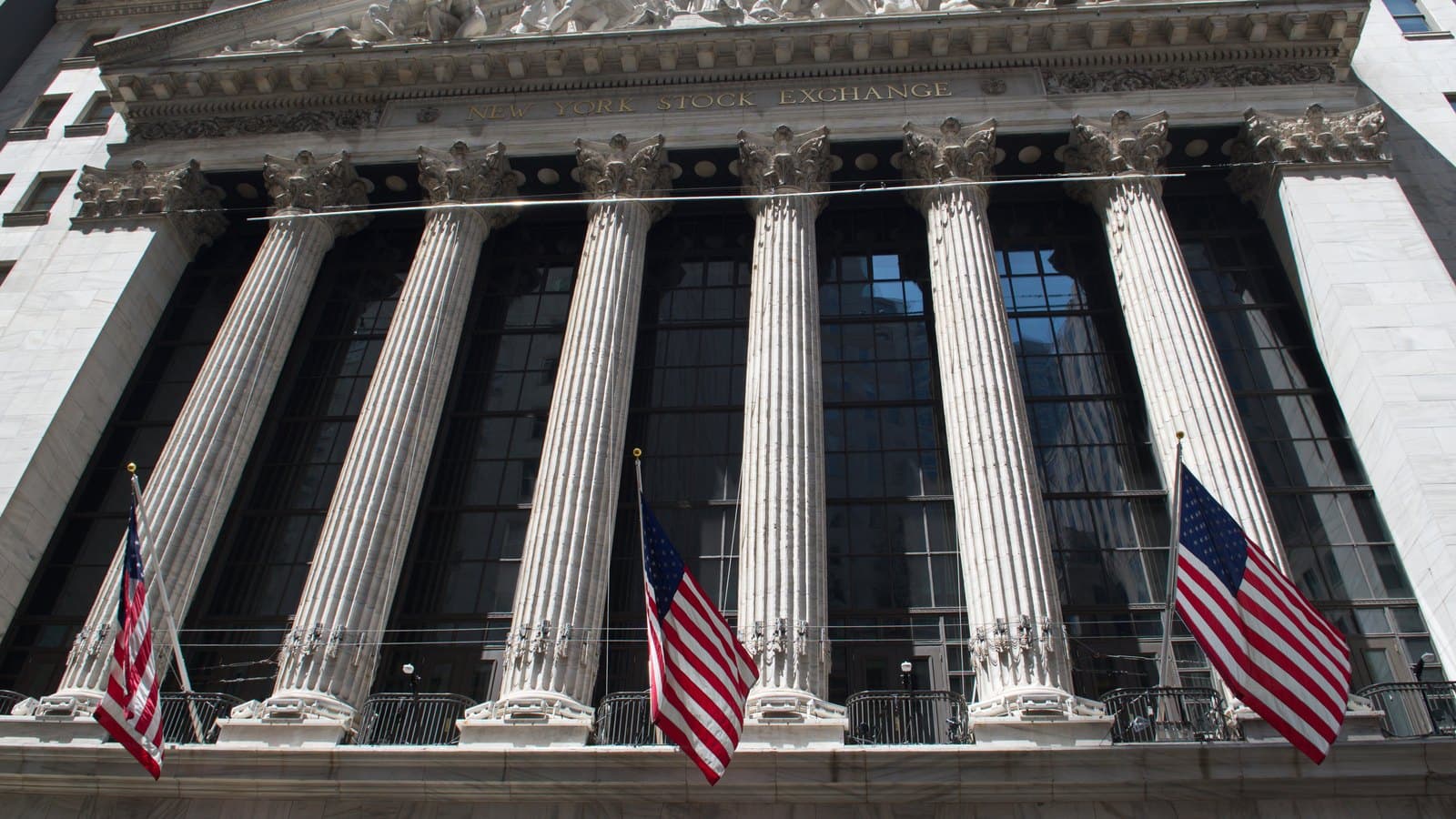
Cover image: the New York Stock Exchange, by 颐园居, CC BY-SA 4.0, via Wikimedia Commons.
Tags
Frequently asked questions
- Why did tech stocks fall on 5 November 2026?
- Investors sold technology and AI infrastructure stocks after Democrats won the House, the Senate and key governorships on 3 November 2026. The market feared slower data center permitting and tighter AI regulation, and the Nasdaq Composite fell 5.52% to 24,315.00.
- How much did the Nasdaq lose in market value?
- The Wall Street Journal put the one-day loss in Nasdaq market capitalization at $2.5 trillion, a single-day record. That is a fall in market value, not cash removed from the economy, and it can reverse with later prices.
- Is this the same as the October 2026 AI debt selloff?
- No. October's selloff centered on credit worries around CoreWeave and other neoclouds, including bond yields and interest costs. The 5 November 2026 rout was triggered by the election result and the risk that data center projects face slower permitting.
- Did any company cancel a data center because of the midterms?
- No hyperscaler announced a cancelled data center on 5 November 2026. The selloff was a repricing of political risk; any change to capital spending would show up later in company guidance.

TPW Editorial
Editorial Team
TechPastWeek's editorial team reports and edits every story we publish. We research each piece against primary and credible secondary sources, and a human editor reviews and signs off before it goes live.