Hubble's N44 Superbubble Becomes a Clock for Star Formation
A new Hubble image of the nebula N44 in the Large Magellanic Cloud pairs a 210-light-year superbubble with a census of nearly half a million stars.

On this page
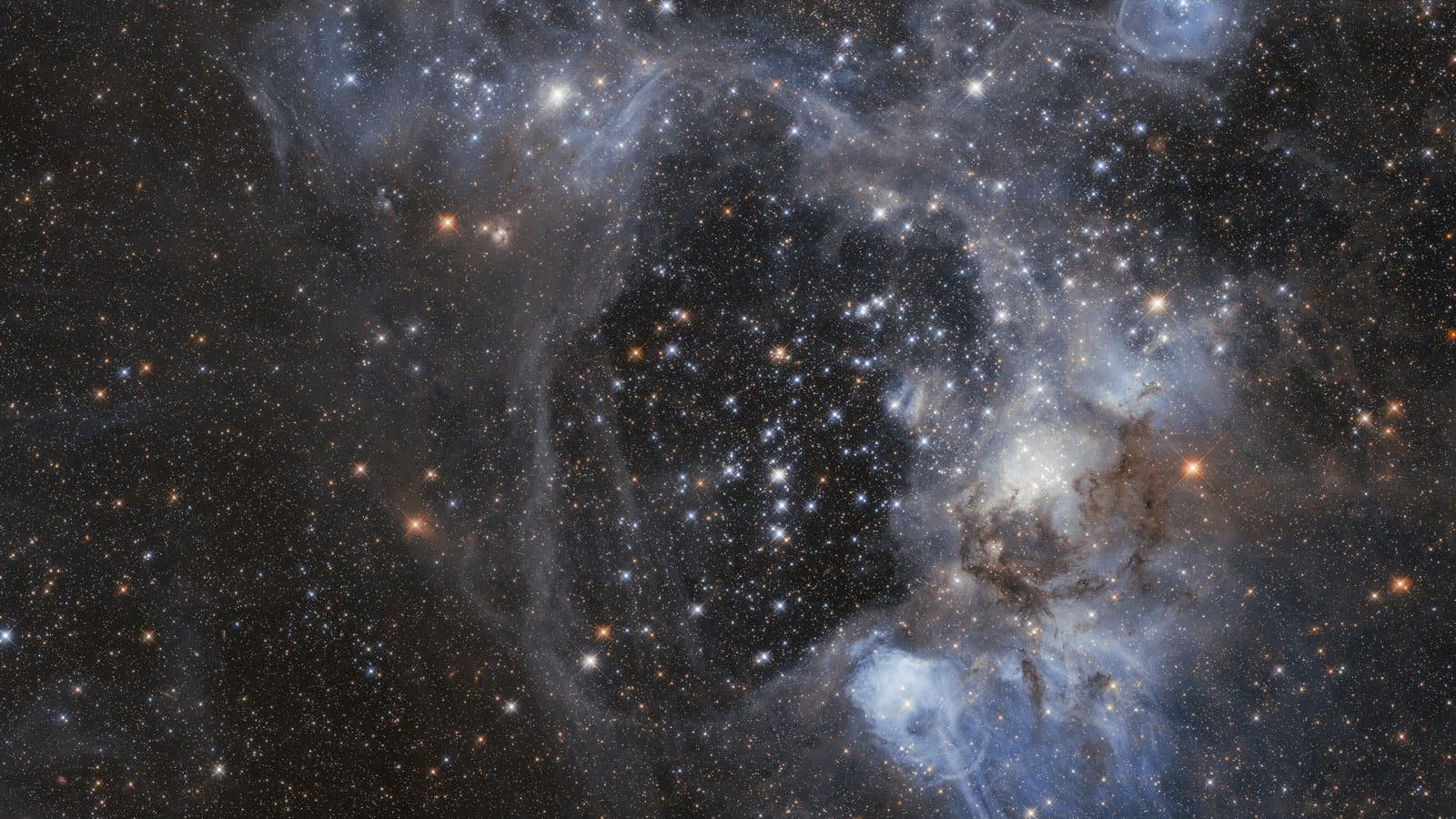
NASA and ESA have released a new Hubble Space Telescope portrait of one of the most scrutinised star-forming regions in the southern sky, and the eye is pulled immediately to what is missing: a vast, dark cavity at the heart of the glowing nebula LHA 120-N44.
Related reading: NASA Asks Industry Whether Commercial Spacecraft Could Boost or Retire Hubble · Hubble and Webb Team Up to Find the Faintest Trans-Neptunian Objects Yet.
The image was published as the ESA/Hubble Picture of the Month on 3 September 2026 and was carried as a NASA image article on 8 September. The ESA/Hubble release shows N44, an emission nebula roughly 160,000 light-years away in the constellation Dorado, inside the Large Magellanic Cloud (LMC), the largest of the small galaxies that orbit the Milky Way. The void at its centre is a “superbubble” spanning about 210 by 140 light-years, as NASA describes it. That scale is difficult to grasp: the entire distance from the Sun to Pluto is less than one light-year, so the cavity is thousands of times wider than the solar system.
The release frames the image alongside a star census of the surrounding cluster, and the combination is what makes N44 interesting to astronomers. It is not simply a pretty nebula; it is a place where the life cycle of stars can be read from a single frame.
A cavity carved by the stars that left it
A superbubble is a region of gas that has been evacuated by the energy of the massive stars born inside it. The Hubble team describes the mechanism plainly: the stars at the centre of the void drove away the material from which they formed. “N44 is dominated by two features: a vast central void and a shell of dense, dusty gas,” the release states. “The glittering stars at the center of the void are responsible for its creation; through their powerful stellar winds and explosive supernovae, these stars expelled much of the gas from which they were born.”
Two processes do the work. First, the most massive stars emit fast, steady outflows (stellar winds) that push surrounding gas outward for millions of years. Then, when the shortest-lived of those stars exhaust their fuel and explode as supernovae, they inject additional energy and sweep more material away. The gas that is pushed outward does not vanish. It piles up at the bubble's edge, forming the dense, dusty shell that appears as a bright rim around the dark interior in Hubble's view.
The shell glows because N44 is an emission nebula: ultraviolet radiation from the surviving massive stars ionises the surrounding gas, which radiates light as it cools and recombines. That is why N44's wispy blue and grey tendrils stand out against the dark lanes of dust in the image.
Not every bubble in the frame is the product of a crowd. N44F, a smaller, distinctly sculpted bubble near the upper-right corner of the image, was carved by the winds and radiation of a single hot, massive star, the team says. It offers a useful comparison: one star can shape a local cavity, while the accumulated feedback of a whole cluster can carve a superbubble hundreds of light-years across.
A superbubble is not an empty hole. The interior still contains extremely thin, hot plasma, and the boundary is a shell of swept-up gas and dust, a moving front where material from the nebula has been compressed. That compression is what makes the rim a plausible site for the next generation of stars.
The census behind the picture
The image is accompanied by a much larger scientific result: a count of the stars in and around the N44 cluster, drawn from a dedicated Hubble survey. According to the NASA release, Hubble catalogued “nearly half a million stars” in the region, including “nearly 30,000” that are pre-main-sequence, young objects that have not yet begun fusing hydrogen into helium in their cores. The data come from observing programme #14689, led by principal investigator D. Gouliermis.
The underlying survey has a name: Measuring Young Stars in Space and Time, or MYSST. Its photometric catalog, published in 2021, contains 461,684 sources observed with Hubble's Advanced Camera for Surveys and Wide Field Camera 3 in two broadband filters. Paper I of the survey reports that the field covers about 180 by 215 parsecs (roughly 590 by 700 light-years) well beyond the central cavity, and reaches deep enough to detect a one-million-year-old pre-main-sequence star with as little as about nine percent of the Sun's mass.
A follow-up analysis published alongside the catalog used machine-learning classification to separate genuine young stars from older field stars that happen to lie along the same line of sight. That study, Paper II, found about 26,700 candidates with a pre-main-sequence probability above 95 percent across N44, and a looser selection of roughly 40,500 at lower confidence. The most probable young stars cluster along the rims of the bubble, especially its western and north-western edges.
That distribution is the scientific payoff. Astronomers are using N44 to time the process of star formation from start to finish: the release says their goal is to understand how long it takes for a cold gas cloud to collapse into dense knots and for nuclear fusion to ignite in a newborn star. The compressed shell is where that clock is running now.
Reading a 210-light-year clock
Star formation is hard to time because most of it is hidden. Stars are born inside cold, dusty clouds that block visible light, and the earliest stages are faint. Hubble helps on both counts: its fine spatial resolution can pick out faint objects in a crowded cluster, and its sensitivity reaches the low-mass stars that dominate a young population but are easy to miss.
N44 is unusually useful because it presents several stages of the process in one place. The central cluster is old enough to have cleared its cavity; the shell around it is dense enough to be forming new stars; and the wider complex contains clouds that have not yet collapsed. The MYSST clustering analysis found the most active star-forming centre at the western edge of the bubble, a subcluster with an effective radius of about 5.6 parsecs containing more than 1,100 pre-main-sequence candidates.
That is the kind of measurement the survey was built for. Counting young stars, mapping where they sit relative to the gas, and estimating their ages together let astronomers connect the superbubble's expansion to the star formation it may be triggering, or shutting down. Massive stars both create the compressed shell that can birth new stars and, through their radiation and eventual explosions, can disperse the remaining gas before more can form. Which effect wins is one of the open questions in star-formation research.
Why the Large Magellanic Cloud matters
The LMC is not only a convenient neighbourhood. It is a satellite galaxy of the Milky Way about 160,000 light-years away, and its gas is poor in elements heavier than helium, what astronomers call “metals.” That low abundance makes the LMC a useful analogue for star-forming regions in the early universe, which formed from gas that had not yet been enriched by generations of stars.
Hubble's ability to detect the lowest-mass stars in this environment opens a window onto star formation in conditions like those of the distant, metal-poor past. The same census that measures how long star birth takes in N44 also probes the masses that newborn stars typically have, a key input for models of how galaxies build their stellar populations. Because the LMC is close enough to resolve individual stars (unlike galaxies at cosmological distances) it is a calibration point.
What the release is, and is not
It is worth being precise about the novelty here, because the framing of a press release can outrun its content. This is a newly released and newly composed Hubble image, and it is genuinely striking. But it is not a new instrument, and the star census at its centre is not new data: the MYSST catalog and its pre-main-sequence analysis were published in 2021. The September release draws fresh attention to an established body of work.
There is also a numerical caveat. The public release says “nearly 30,000” pre-main-sequence stars, while the 2021 high-confidence selection contained about 26,700, a difference that reflects how a “young star” is defined and how confident the classification is, not a disagreement about the dataset. The “nearly half a million” figure refers to the full catalog of sources, including older stars and interlopers drifting in front of the cluster, not to the young stars alone.
Distance is another place where numbers are commonly rounded. The new release uses 160,000 light-years; older material sometimes cites about 170,000. The difference is a matter of measurement and convention rather than a physical change.
Finally, an image alone cannot prove that a particular star was born because of the bubble. Establishing that connection requires comparing the positions, ages and properties of many objects, which is exactly what the clustering analysis attempts, and what future follow-up will test.
What to watch
Three things will show how much more N44 has to teach.
- Follow-up work that turns the pre-main-sequence candidate lists into firm ages and masses. The survey's deep photometry makes that possible; spectroscopy is needed to confirm the youngest objects.
- Infrared observations that peer through the dust where star formation is still embedded. Hubble sees the exposed young stars and the shell; infrared and submillimetre facilities see the cold clouds before they collapse.
- Whether the N44 results transfer to other metal-poor regions. If the LMC's conditions really do resemble the early universe, then the way stars form and cluster there is a clue to how the first generations of stars shaped their galaxies.
For now, the new Hubble view does what the best astronomical images do: it makes an abstract process legible. A 210-light-year cavity, a glowing shell, and a catalogue of nearly half a million stars together describe how one generation of stars can clear a space, and, perhaps, seed the next.
Cover image: the nebula N44, processed by Judy Schmidt from NASA/ESA/Hubble data (D. Gouliermis), via Wikimedia Commons, CC BY 2.0.
Tags

TPW Editorial
Editorial Team
TechPastWeek's editorial team reports and edits every story we publish. We research each piece against primary and credible secondary sources, and a human editor reviews and signs off before it goes live.