Hubble and Webb Team Up to Find the Faintest Trans-Neptunian Objects Yet
Hubble and Webb joined forces for the deepest survey of trans-Neptunian objects, finding 27 tiny icy worlds that preserve the early solar system's history.

On this page
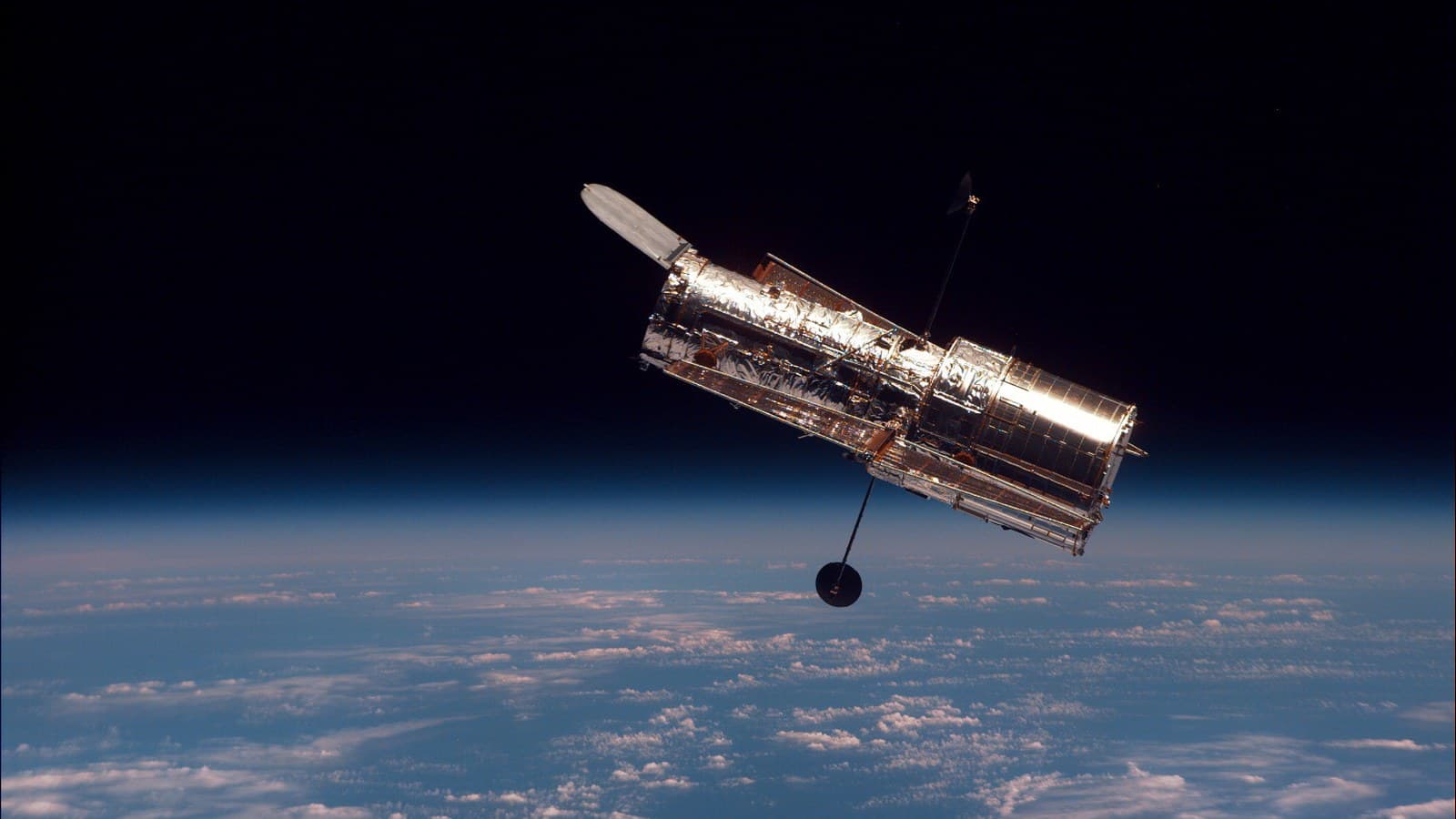
For the first time, astronomers have aimed NASA's Hubble and James Webb space telescopes at the same patch of sky to hunt for the smallest, faintest objects in the outer solar system. The result, announced on September 8, 2026, is a catalog of 27 newly discovered trans-Neptunian objects (TNOs) (icy leftovers from the solar system's construction), including bodies only a few kilometres across and one so dim the team likens it to spotting a swarm of fireflies on the Moon.
Related reading: NASA Asks Industry Whether Commercial Spacecraft Could Boost or Retire Hubble · Hubble's N44 Superbubble Becomes a Clock for Star Formation.
The two papers behind the work, both published that day in The Astronomical Journal, describe the deepest survey of its kind and reach a population of ancient planetesimals that even the most sensitive ground-based telescopes cannot see. One study, led by Marielle Eduardo of the University of Victoria, measures how many objects of each size exist; the other, led by Anastasia Morgan of Northern Arizona University, measures their colours and spins. Together they attack a question that has shadowed planet-formation theory for decades: what did the solar system's building blocks actually look like before they became planets?
The search for the smallest worlds
Trans-Neptunian objects orbit the Sun beyond Neptune, in the cold, dark reaches of the Kuiper Belt and beyond. They are time capsules. Because they never merged into planets, their surfaces have recorded the composition of the disk of gas, dust and ice from which the solar system formed, roughly 4.5 billion years ago. Most are more than 100 million times dimmer than objects the unaided eye can see, which is why they are so hard to find.
The JWST survey, a James Webb program designated Cycle 1 #1568, was built to push past that limit. The Eduardo team's paper reports that Webb's Near-Infrared Camera, or NIRCam, imaged a 0.05-square-degree strip of sky on the solar system's invariable plane (a patch chosen for its low density of background stars) in three observing epochs spread roughly five days apart, between January 24 and February 4, 2023. Astronomers then combined a "shift-and-stack" technique, which co-adds images along an object's likely path to boost faint signals, with a machine-learning filter trained to reject the false positives that process inevitably creates.
The depth they achieved was unprecedented. The survey reached a 40% detection threshold of magnitude 28.8 in the F150W2 filter, equivalent to about magnitude 29.8 in the red band used by ground telescopes. Its single faintest detection came in at magnitude 29.3. NASA's release describes the smallest object found at about 3 miles (5 kilometres) across, roughly five times smaller than the best ground-based surveys can detect. Those diameters are estimates rather than direct measurements, derived from brightness under an assumed albedo; the faintest detection works out to about 10 kilometres at a 15% albedo, so the size figures move with that assumption.
The Hubble observations were designed as the visible-light complement. The Morgan team's paper describes HST Cycle 29 program #16720, which used the ACS/WFC and WFC3/UVIS cameras in nine pointings of eleven orbits each, 99 orbits in total, taken between January 24 and February 3, 2023, to overlap Webb's field. The Hubble mosaic covered about 65% of the Webb footprint, and recovered 13 of the Webb-detected objects in visible light, yielding colour measurements that span wavelengths from 0.35 to 3.2 micrometres.
Why two telescopes
Webb is most sensitive in the infrared, where cold, distant objects radiate much of their faint glow, and it is the machine that finds them. Hubble is sensitive in visible light, where surface colour (a fingerprint of what an object is made of) is easiest to read. Neither telescope could have produced the result alone: Webb supplied the detections, Hubble supplied the optical colours needed to compare the smallest bodies with their larger siblings.
The colours are the surprise
The headline finding is not the number of objects but what their surfaces look like. Previous work had established that large cold classical TNOs (the population that orbits the Sun on low-inclination, nearly circular paths and probably formed where it is today) occupy a single "reflectance sequence," a smooth trend in colour that points to a common, primordial surface composition. The open question was whether the smallest cold classicals follow the same trend, or whether billions of years of collisions had ground their surfaces into something different.
They follow it. The Morgan team found that the colour distribution of their small cold classical TNOs is narrow and consistent with the same single sequence seen at larger sizes, with no evidence of a break at small diameters. The dynamically excited objects (the "hot" population, which formed closer in and was scattered outward by the migrating giant planets), instead span a broader range of colours, matching the multiple compositional classes seen among larger excited TNOs.
That is not what many researchers expected. Small bodies should be the most heavily battered, so their surfaces ought to look more processed than those of big objects. Instead, the tiny TNOs seem to have held on to the signature of where and when they formed.
"You could imagine a scenario where getting knocked around and fragmented would change the surface composition, and then you would see a different surface color for tiny TNOs compared to their larger siblings," Morgan said in NASA's release. "So it's really fascinating to see that the smallest objects are somehow 'remembering' and preserving the history of how they were made."
The same message holds for the excited population. "These dynamically 'hot' TNOs retain a signature of where they were born, even though they've been orbitally scrambled since then," said co-author David Trilling of Northern Arizona University.
Fewer small objects than models predicted
The second paper counts. By measuring how many objects appear at each brightness, the Eduardo team built a luminosity function (a proxy for the size distribution) and found the apparent magnitudes fit a single power law, dN/dm ∝ 10^(αm), with a slope of α = 0.29 (plus 0.08, minus 0.07). Crucially, the cold and hot subpopulations are consistent with the same slope, even though they are thought to have formed at different distances from the Sun, roughly 25 and 45 astronomical units.
The practical implication is that planetesimal formation seems to have been surprisingly insensitive to local conditions. Whether the disk was dense or thin, hot or cold, it produced a similar spread of object sizes. "The process seems to be insensitive to disk conditions, producing similar planetesimal sizes whether the disk is hot or cold, and dense or fluffy," Eduardo said.
But the survey also found fewer very small bodies than some planet-formation models predicted. That is a genuine tension, and it cuts to the heart of how the first solid building blocks formed. One leading model holds that planetesimals assembled through the "streaming instability", a feedback loop in which pebbles concentrate into dense clouds that then collapse under their own gravity, producing objects around 100 kilometres across. The size distribution measured here feeds directly into tests of that model, and the shallow faint end is a constraint the theorists will have to absorb. The Eduardo paper also uses the detections to revisit the total mass of the Kuiper Belt, one of the bookkeeping numbers that planet-formation models depend on.
A contact binary in the field
One object stands out from the rest. The survey deliberately included a previously known TNO, 2015 GK56, to test the recovery pipeline. It turned out to be the most interesting object in the sample: its lightcurve (the way its brightness rises and falls as it spins) has a large peak-to-peak amplitude of about 0.6 magnitudes and a structure of V-shaped troughs and inverted-U peaks that the team attributes to a contact binary, two lobes touching in a peanut shape. The joint Hubble–Webb fit gives it a rotation period of about 16 hours. It is the only likely contact binary in the sample.
Contact binaries are common among the Kuiper Belt's larger members, and their shapes are a clue to how gently (or violently) planetesimals came together. Finding one among the small, faint objects helps anchor the new population to the better-studied one.
Why it matters
The outer solar system is a natural laboratory for the first chapter of planetary history, and this survey reads a page that was previously blank. By extending colour and size measurements down to bodies a few kilometres wide, the two teams show that the primordial signal survives at the smallest scales yet observed. That pushes against the idea that collisions dominated the evolution of small TNO surfaces, and it supports models in which planetesimals formed quickly from the gravitational collapse of pebble clouds, preserving their birth composition.
There is a practical payoff, too. The methods here (shift-and-stack detection, machine-learning vetting, and joint visible–infrared photometry across two observatories) are a template for using Hubble and Webb together on other faint, moving targets. As Webb racks up more deep imaging, those tools will matter well beyond the Kuiper Belt.
Caveats
Several are worth keeping in view. The observations are from early 2023, and the analysis took years to complete; the announcement is of published results, not new data. The sample of 27 objects is small, and the size estimates depend on assumed albedos, which are uncertain for objects this faint. The single power-law fit has sizeable error bars. And while the results are consistent with a primordial origin, the teams cannot yet say whether the small TNOs truly escaped collisional processing or whether collisions are simply rarer in the outer reaches than models assume. The papers themselves note the mystery is unresolved.
What to watch
Three things will show whether this picture holds. First, more objects: a larger sample will sharpen the faint end of the size distribution and test whether the shallow slope is real. Second, spectroscopy from Webb, which can identify the specific ices and organic materials behind the colours rather than inferring composition from broadband shades. Third, theory: whether models of streaming instability and pebble-cloud collapse can reproduce a size distribution that is so similar across the hot and cold populations, and so poor in the very smallest bodies.
The deepest survey of trans-Neptunian objects has done what the best surveys do: it has answered a question and opened two more. The smallest worldlets beyond Neptune appear to be faithful copies of their larger relatives, small, ancient, and still carrying the recipe from which the planets were made.
Tags

TPW Editorial
Editorial Team
TechPastWeek's editorial team reports and edits every story we publish. We research each piece against primary and credible secondary sources, and a human editor reviews and signs off before it goes live.