NASA Asks Industry Whether Commercial Spacecraft Could Boost or Retire Hubble
NASA's 29 October 2026 request for information asks industry about boosting Hubble, servicing it, or bringing it down safely. Nothing is funded or scheduled.

On this page
Key takeaways
- NASA issued a Request for Information on 29 October 2026 asking industry about commercial boosting, servicing or controlled disposal for the Hubble Space Telescope.
- Responses to the RFI are due by 3 p.m. EST on Monday, 30 November 2026.
- Hubble has no propulsion system, and NASA's analysis projects re-entry in the 2033-2034 timeframe, with a mission needing to take place by 2032.
- NASA's 29 October 2026 request is not a contract, award, budget line or approved mission, and no company, cost estimate, launch date or vehicle has been selected.
- Hubble launched in 1990, has operated for more than 35 years, and is a NASA/ESA project managed by Goddard Space Flight Center.
NASA issued a Request for Information on 29 October 2026 asking commercial space companies what they could do about the Hubble Space Telescope. The document lists three possibilities: boost the observatory to a higher altitude to extend its science lifetime, service it to enhance its capabilities, or perform a safe, controlled re-entry or orbital disposal at the end of the mission. Responses are due by 3 p.m. EST on Monday, 30 November 2026.
Related reading: NASA's Roman Space Telescope Launches on a Million-Mile Hunt for Dark Energy · NASA Picks PRIMA, a Billion-Dollar Far-Infrared Telescope, for a 2033 Launch.
None of that is a mission. An RFI is a market survey, and NASA's announcement describes this one as a request for industry input on commercial in-space servicing. The notice on SAM.gov is a request for information, not a solicitation. No company is named. There is no cost estimate, no launch date, no vehicle and no service provider. Nothing is funded, selected or scheduled.
The paperwork is more modest than the headline. Hubble is running out of altitude, NASA would like to keep it working, and the agency is testing whether the commercial space industry has matured enough to make an offer.
Three different jobs on one page
The three options are not variations on a theme. They describe different missions, with different engineering, different risk and different customers.
A boost is a propulsion problem. Something has to reach Hubble, raise its orbit and then stop pushing. Servicing is a robotics and proximity problem: a visiting vehicle has to reach the telescope, attach or dock, and do useful work on hardware that was designed around Space Shuttle crews. Disposal is a debris problem, and the hard part comes at the end, when a satellite has to come down over an ocean instead of wherever drag finally wins.
A company could answer on one of those and decline the other two. NASA asked about all three in a single document, which suggests the agency wants the whole menu priced and judged at once. It also means the responses will be hard to compare. A bid to add years of altitude and a bid to remove the telescope safely are not competing for the same contract, even if they arrive in the same inbox.
The wording is broad on purpose. "Enhance its capabilities" could mean almost anything, and the notice does not define it. That vagueness is normal at this stage, when an agency asks what industry can offer before deciding what to ask for. It also makes the answers hard to score, since one company's idea of an upgrade may be another's idea of a new mission.
The document does not rank the options either, which fits the purpose. NASA is trying to learn which of the three a commercial provider could actually deliver, and at what price, before it commits to a requirement. A ranked list would have narrowed the answers too early.
A telescope with no engine
Hubble has no propulsion system. It cannot raise its own orbit, and drag from the thin gas at its altitude keeps pulling it down. NASA's analysis puts re-entry in the 2033-2034 timeframe. The agency says a mission would need to take place by 2032.
Both dates need handling with care. The 2032 figure is NASA's planning assumption for when a mission would have to fly, not a scheduled launch. The 2033-2034 figure is a projection, and projections of orbital decay move with solar activity, which changes how much the upper atmosphere expands and how much drag Hubble meets. A quiet Sun and an active Sun produce different calendars.
What does not change is the direction. Without a boost, the telescope comes down. The only question is when, and whether the end is controlled.
Orbital decay is gentle, and it does not stay gentle. The lower the telescope sinks, the thicker the atmosphere it meets, and the faster it loses height. The end is not a single event that can be postponed indefinitely. It is a curve, and NASA is choosing where on that curve to act.
More altitude means more time. Every extra year is another cycle of proposals, another set of observations, another chance to follow up on something unexpected. The science case for Hubble does not end because the hardware is old. It ends when the orbit does.
Altitude is not a refurbishment
A higher orbit extends the mission's lifetime. It does not repair ageing instruments or gyroscopes. NASA's request asks about lifetime and capability as separate questions.
Why the agency is asking now
Administrator Jared Isaacman framed the request as an obligation to look. "Hubble still has important science ahead of it, and we should be looking at every reasonable opportunity to keep it delivering for as long as possible," he said in the NASA release.
If there are innovative and cost-effective ways to extend the life of an asset already on orbit, we owe it to the American taxpayer and the scientific community to explore them.
Nicky Fox, associate administrator for the Science Mission Directorate, tied the request to changes in industry. Hubble is "a national icon that has fundamentally changed how humanity views our universe for more than 35 years," she said. Commercial companies have rapidly evolved in satellite capture and servicing, and NASA is "eager to explore the breadth of possibilities to boost Hubble to a higher orbit while we develop the flagship mission to follow."
That phrase also sets the sequence. NASA's next large observatory program has no name in the release and no date. A Hubble boost is being studied alongside the telescope that comes after it, not instead of it. The release does not identify that observatory, and readers should not assume the reference is to a mission already in development.
The timing reflects a bet about the servicing market. NASA is not asking a contractor to solve a known problem. It is asking whether a commercial sector exists that can price and fly this kind of work. Fox describes an industry that has rapidly evolved in capture and servicing. The RFI asks whether that progress is enough for Hubble.
Hubble is also an unusual target. It is a working scientific instrument with a long operational history, not a dead satellite waiting to be removed. A mission that damages it would be worse than no mission at all.
The disposal option nobody headlines
The third option is the one that will happen eventually. A controlled re-entry or orbital disposal would end the mission deliberately, with the telescope brought down in a way that limits debris risk.
The alternative is an uncontrolled re-entry, which is what happens if nothing is done. An uncontrolled return leaves the debris risk to chance. A controlled disposal reduces it, at a cost: it requires a capable vehicle and a funded mission whose only product is an ending. The RFI asks industry what that would take.
Disposal also has an engineering appeal the other options lack. It is a defined problem with a measurable success condition, since the telescope enters the atmosphere on a planned path at a planned time. A boost has to work well enough to matter. A disposal either happens as designed or it does not.
There is an awkward politics to this. Spending public money to bring down a beloved telescope is harder to announce than spending it to save one. Yet the disposal question has a deadline that cannot be argued with, and the earlier it is studied, the more choices remain. A plan made at the last minute has fewer options than one made now.
What the answers can show
The RFI closes on 30 November. After that, NASA will have a stack of industry responses. What it does with them is not yet public, and no outcome is promised.
Three things are worth watching in the responses.
Whether anyone claims a credible boost. The technical bar is high: reach Hubble, match its orbit, attach or dock, and apply enough push without damaging a structure that has been in orbit since 1990. Fox's comment that industry has evolved in capture and servicing is an invitation to prove it.
Whether cost figures appear. Isaacman's phrase "cost-effective" sets the test. A commercial boost that costs more than the science it buys would be hard to defend, and no one has published a number yet.
Whether disposal gets a serious bid. A company that can remove Hubble safely is offering NASA something it will need whatever happens with the boost. That may turn out to be the most commercially realistic part of the request.
Responses to an RFI are usually not public. Companies treat their answers as competitive information, and NASA does not have to publish them. The public may learn what the agency decides long before it learns what industry proposed, if it learns at all.
The gap after Hubble
Hubble launched in 1990 and has operated for more than 35 years. It is a NASA/ESA project. Goddard Space Flight Center manages the telescope and mission operations, Lockheed Martin Space supports mission operations at Goddard, and the Space Telescope Science Institute conducts science operations.
An asset like that is hard to replace. The case for a boost is not nostalgia. The telescope still produces science, and the years between now and the next flagship observatory are years when that science would otherwise be missing. NASA has not said how long that gap would be, and the RFI does not answer it.
That silence is part of what the request is testing. If industry can put a price on keeping Hubble alive, NASA can compare it with the cost of losing the observing time. If industry cannot, the agency learns that too, and the telescope's remaining years become a countdown rather than a choice.
The gap is about more than hardware. It is about the people who depend on it: the astronomers whose proposals rely on the telescope, the staff who keep its data usable, and the engineers at Goddard and Lockheed Martin who run the mission. A gap in observing time is easier to describe than a gap in a workforce, and harder to fix.
The Verge covered the request on 1 November. Public attention can help a program find money. It can also raise expectations that a request for information cannot meet.
For now, the summary is short. NASA has asked a question. Industry has until the end of November to answer. The telescope will keep descending while everyone waits.
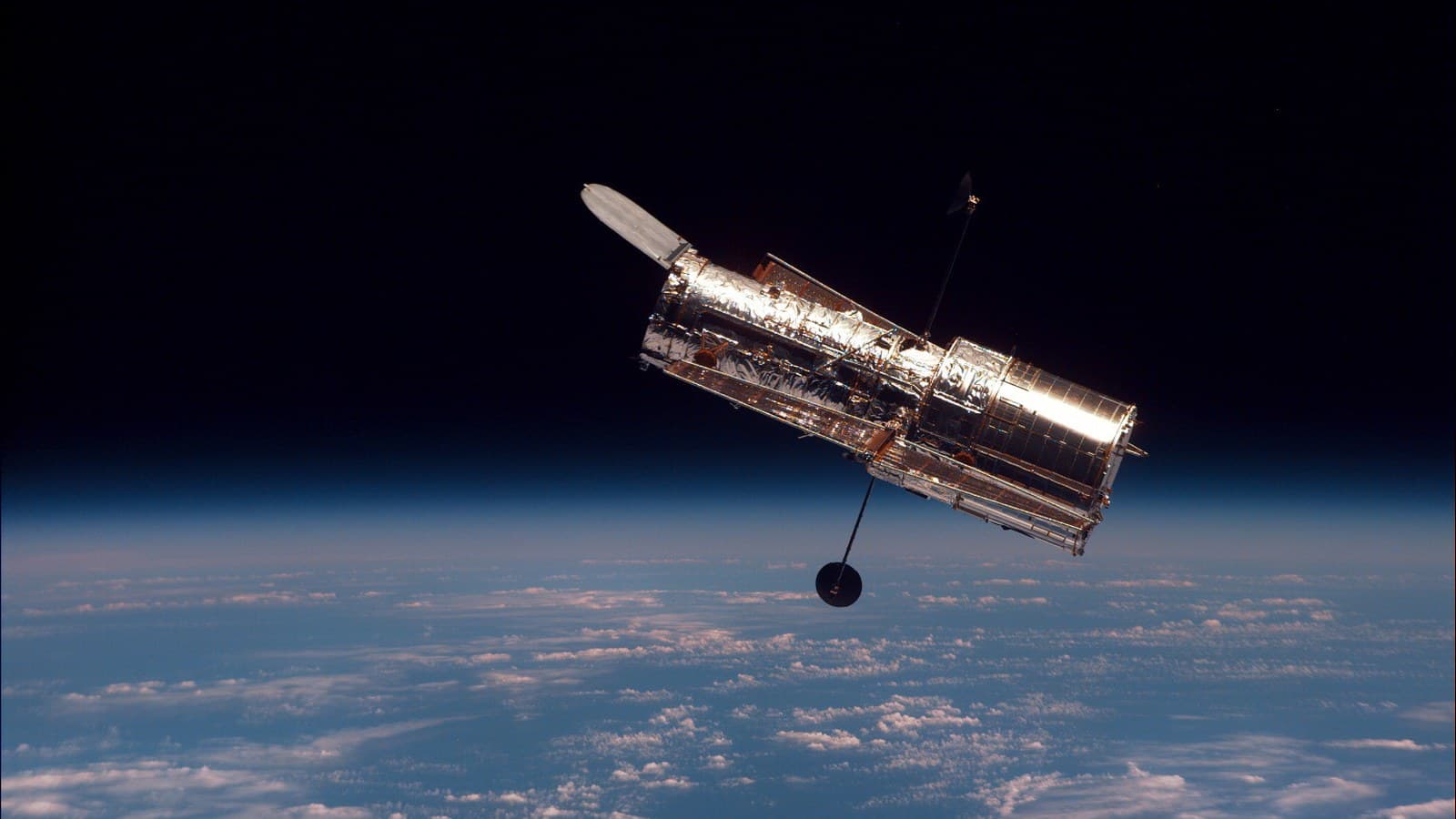
Cover image: the Hubble Space Telescope orbiting above Earth, NASA (public domain), cropped 16:9.
Tags
Frequently asked questions
- Is NASA going to boost the Hubble Space Telescope?
- Not yet. NASA issued a Request for Information on 29 October 2026 to ask industry what a commercial boost, servicing mission or controlled disposal could look like. Nothing is funded, selected or scheduled, and responses are due by 30 November 2026.
- When will Hubble re-enter Earth's atmosphere?
- NASA's analysis projects re-entry in the 2033-2034 timeframe. That is a projection rather than a fixed date, and it can change with solar activity and atmospheric drag.
- Why does Hubble need a boost?
- Hubble has no propulsion system, so atmospheric drag keeps lowering its orbit. A boost to a higher altitude would extend its science lifetime. NASA says a mission would need to take place by 2032 under its planning assumption.
- Would a boost make Hubble as good as new?
- No. Raising the orbit extends the telescope's lifetime but does not repair ageing instruments or gyroscopes. NASA's request treats lifetime and capability as separate questions.

TPW Editorial
Editorial Team
TechPastWeek's editorial team reports and edits every story we publish. We research each piece against primary and credible secondary sources, and a human editor reviews and signs off before it goes live.