NASA Picks PRIMA, a Billion-Dollar Far-Infrared Telescope, for a 2033 Launch
NASA selected PRIMA, a $1.2 billion far-infrared space telescope, as the first Probe Explorers mission in its Explorers Program, targeting a 2033 launch.

On this page
Key takeaways
- NASA selected PRIMA, the PRobe far-Infrared Mission for Astrophysics, on September 23, 2026, as the first mission in its new Probe Explorers class.
- PRIMA is targeted to launch in 2033 for a planned five-year mission, with a project cost capped at $1.2 billion if the mission passes its confirmation review.
- The observatory pairs a cryogenically cooled 1.8-meter telescope with two instruments, the PRIMAger imaging polarimeter and the FIRESS spectrometer, covering far-infrared wavelengths from 24 to 235 micrometers.
- NASA's Jet Propulsion Laboratory will manage PRIMA, Caltech's IPAC will serve as the mission science center, and Germany's Max Planck Institute for Astronomy is contributing beam-steering mirrors.
- PRIMA became the sole finalist for the first Probe Explorer after NASA disqualified the competing AXIS X-ray mission in March 2026.
NASA will build a telescope to study the coldest and dustiest parts of the universe. On September 23, 2026, the agency selected PRIMA, the PRobe far-Infrared Mission for Astrophysics, as the first mission in a new class of astrophysics observatories called Probe Explorers, and advanced it into the next stage of development.
Related reading: NASA Asks Industry Whether Commercial Spacecraft Could Boost or Retire Hubble · NASA's Roman Space Telescope Launches on a Million-Mile Hunt for Dark Energy.
The decision puts NASA on a path to launch the observatory in 2033 for a planned five-year mission. The agency presents PRIMA as a bridge across a gap in its fleet: a far-infrared surveyor that covers wavelengths falling between those of the James Webb Space Telescope and ground-based radio arrays.
"The PRIMA mission is humanity's next window into the deep universe," said Nicky Fox, associate administrator for NASA's Science Mission Directorate. "It will unveil the obscure across cosmic time to better understand the formation of planets, stars, black holes, and even how water on Earth came to be."
A telescope built to run cold
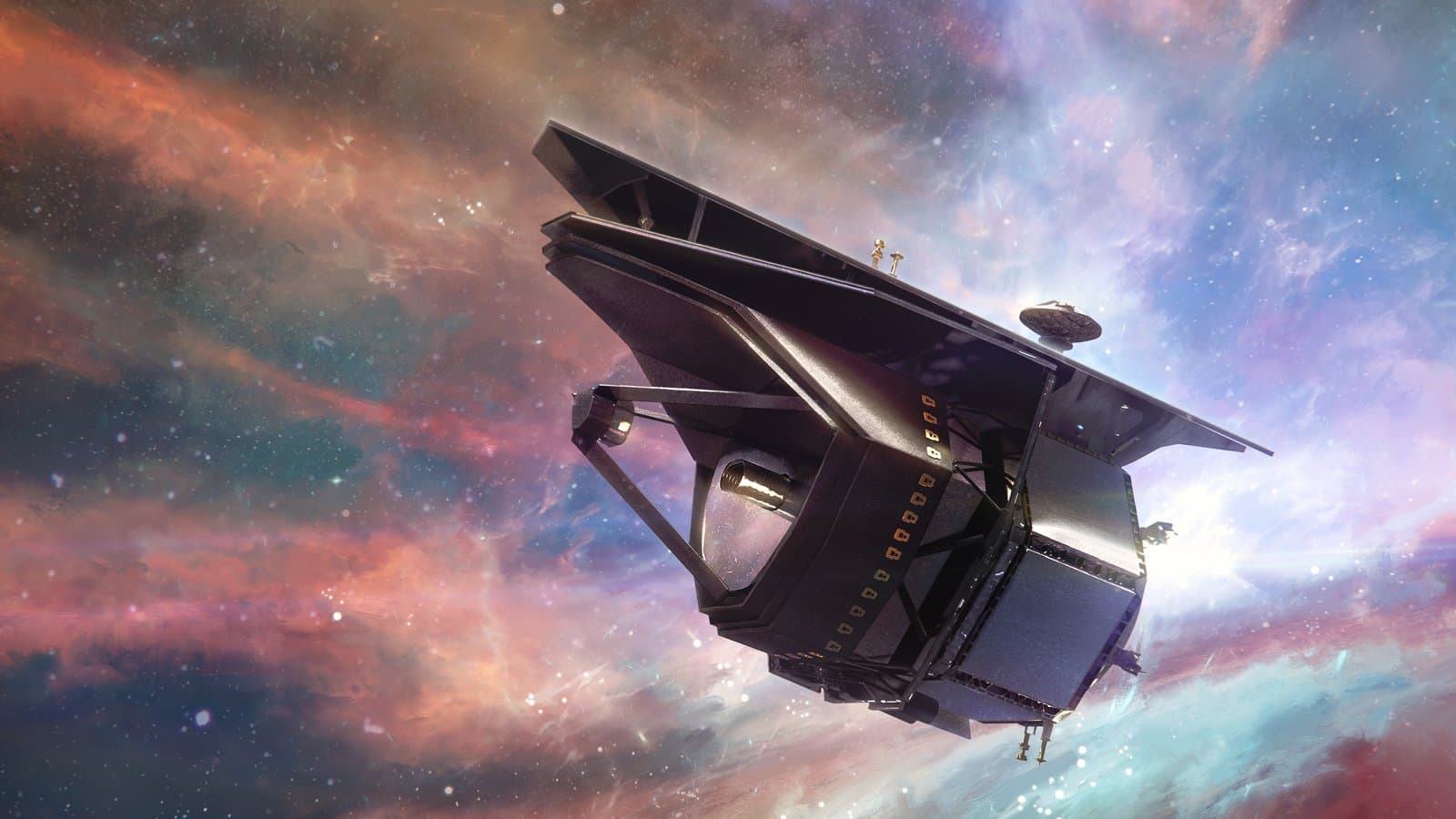
PRIMA's primary mirror measures 1.8 meters, or 5.9 feet, across. The optics are designed to be cryogenically cooled to about 4.5 kelvin, close to minus 451 degrees Fahrenheit. Ars Technica reports that the focal planes of the mission's kinetic inductance detectors will be chilled further, to roughly 100 millikelvin, which would place the observatory among the coldest ever sent to space.
The cooling is central to the design rather than an engineering flourish. At far-infrared wavelengths, warm optics glow brightly and can drown out faint sources. TU Delft, whose researchers are working on PRIMA's detector systems, describes the mission as the first space telescope with an actively cooled mirror, and estimates that the approach makes it between a thousand and a hundred thousand times more sensitive than earlier far-infrared telescopes.
Rather than develop a new cryocooler from scratch, PRIMA will reuse a spare left over from the development of Webb's Mid-Infrared Instrument, modified to use helium-3 as the cooling fluid, according to Ars Technica.
Two instruments carry the science. PRIMAger is an imaging polarimeter built to map wide areas of sky, and FIRESS is a high-resolution spectrometer for detailed studies of individual targets. Together they cover wavelengths from 24 to 235 micrometers. Caltech notes that 235 micrometers is roughly the thickness of two stacked sheets of paper, while 24 micrometers is about a third the thickness of a human hair. NASA expects the observatory to weigh under 3.4 metric tons at launch and to operate from the Sun-Earth L2 Lagrange point, about a million miles from Earth.
PRIMA is moving into Phase B, which advances preliminary design and technology work. A confirmation review will follow, based on technical, programmatic and cost performance, before NASA decides whether to begin implementation in Phase C. The $1.2 billion figure is a project cost cap that applies only if the mission is confirmed, and it excludes launch and other non-project costs.
What far-infrared light reveals
Far-infrared radiation comes from cool material: cold dust, gas, and the dense regions where stars and planets take shape. Much of that signal never reaches ground-based optical telescopes because dust obscures the view, which is why astronomers have long wanted a dedicated space observatory at these wavelengths.
NASA says PRIMA will address the origins of planets outside the solar system, how galaxies and their black holes grew and evolved across cosmic history, and how dust and heavy elements accumulated over time, all of which shape why the universe looks as it does today. The agency's astrophysics division director, Shawn Domagal-Goldman, framed the mission as one entry in a longer sequence.
"A single mission alone can't probe all the universe's mysteries," he said. "But by extending the survey capabilities of our fleet into far-infrared wavelengths with PRIMA, we're enabling an incredibly comprehensive look at the cosmos."
Caltech describes the target as the cold, dusty universe and says PRIMA will help study star and planetary system formation, trace galaxy evolution, and characterize the composition of exoplanet atmospheres and solar system bodies. Jonas Zmuidzinas, the Caltech physicist whose work underpins the mission's detectors, put the scale of the hoped-for gain plainly.
"PRIMA represents something that occurs rarely in astronomy: In this less-explored wavelength band, the far infrared, we have a chance to leap forward in sensitivity by about a factor of a thousand," he said. "That's very rare."
The detectors themselves trace back to 1999, when Zmuidzinas and JPL engineer Rick LeDuc worked out how to use superconducting materials to sense far-infrared light, Caltech said. The same technology, known as kinetic inductance detectors, is now the basis for the mission's cameras and spectrometer.
Far-infrared is also a blind spot. With no observatory of this kind now flying, astronomers have lost routine access to wavelengths that trace water and other molecules in star-forming clouds, the glow of cold dust in distant galaxies, and the magnetic fields threaded through the clouds that collapse into stars. Ars Technica notes that PRIMA is designed to build on discoveries from Europe's Herschel space telescope, which gave researchers new insight into the role of water in the formation of stars and planets. NASA describes the new mission as a deep survey instrument rather than a visitor to a handful of targets.
Who is building PRIMA
NASA's Jet Propulsion Laboratory in Southern California will manage the mission. Caltech, which operates JPL for NASA, says the laboratory will lead mission architecture, systems engineering, and integration of the spacecraft and payload. NASA's Goddard Space Flight Center in Maryland and Marshall Space Flight Center in Alabama are partners, and Caltech's IPAC will serve as the mission science center, receiving, processing and archiving the data and scheduling observers' time.
The mission also carries a set of international contributions. NASA lists France's CNES, Italy's ASI, Germany's DLR, the Canadian Space Agency, South Korea's KASI with KASA, Japan's JAXA, and the UK Space Agency. Germany's Max Planck Institute for Astronomy is providing key optomechanical hardware: two actively controlled beam-steering mirrors, one for each instrument, along with the control electronics, according to the Max Planck Society.
"We are proud that, thanks to our expertise, MPIA once again contributes to a groundbreaking NASA space telescope now selected for the next step of development," said Oliver Krause, who leads the institute's Infrared Space Astronomy Group and is a PRIMA co-investigator.
Thomas Henning, an MPIA director emeritus and another co-investigator, said the institute's observing access was part of the appeal. "PRIMA will provide valuable observations for several key research areas at our institute, such as planet and star formation, which we can access thanks to our proposed hardware contributions," he said.
Once the observatory is working, about 75 percent of its observing time will be open to the general astronomy community through peer review, according to Caltech. The team has already collected nearly 200 ideas for using the data from more than 400 astronomers.
Why NASA created a new mission class
PRIMA is the first entry in the Probe Explorers line, a category NASA established on the recommendation of the 2020 astrophysics decadal survey, "Pathways to Discovery in Astronomy and Astrophysics for the 2020s." The idea was to fill the space between relatively inexpensive Explorer-class missions and flagship observatories such as the Nancy Grace Roman Space Telescope, which Ars Technica reports cost about $4.3 billion.
That middle tier has been a subject of debate for years, and PRIMA did not emerge from a crowded field. The competition dates to October 2024, when NASA selected PRIMA and the Advanced X-ray Imaging Satellite, or AXIS, for 12-month concept studies worth $5 million each and said it expected to pick one for construction in 2026. At the time, NASA described PRIMA as a 1.8-meter telescope that would bridge the gap between Webb and radio observatories and named Jason Glenn of NASA Goddard as its principal investigator. AXIS was disqualified in March 2026 after its concept study came in about 10 percent over budget and did not meet the required schedule, according to Science. Its principal investigator, Christopher Reynolds of the University of Maryland, blamed agency management for the outcome, saying the mission fell victim to programmatic disruption at Goddard.
PRIMA's expected cost has shifted in the other direction. NASA's 2024 announcement said Probe Explorer mission costs were capped at $1 billion each; the current figure is $1.2 billion, excluding launch and other non-project costs.
The selection lands as NASA's science budget faces political pressure, and as the agency weighs far larger ambitions. NASA is running preliminary studies for the Habitable Worlds Observatory, a flagship planned for the 2040s that Ars Technica reports carries early cost estimates near $11 billion. Domagal-Goldman said the agency hopes to apply lessons from Roman, which launched on schedule and on budget, to keep future flagships under tighter control.
What still has to happen
The announcement is not a final commitment to build the flight hardware. PRIMA must pass a confirmation review before NASA approves implementation, and the launch provider has not been chosen. The 2033 date is a target, and NASA's own language leaves room for the schedule and cost picture to change.
For astronomers, the practical question is whether a far-infrared observatory can finally reach orbit after a long gap. NASA has no far-infrared space telescope operating now. The European Space Agency's Herschel telescope, which pioneered much of the science PRIMA is designed to extend, was retired in 2013, and the Spitzer Space Telescope, which worked at shorter infrared wavelengths, was shut down in 2020.
If PRIMA survives its reviews, it would reopen a window that has been closed for more than a decade, and one of the few remaining blind spots in astronomy. The mission's sensitivity claims, its schedule and its final cost will all be tested before the telescope reaches L2. Until then, the 2033 launch is a plan rather than a guarantee.
Cover image: an artist's concept of NASA's PRIMA observatory. Image: NASA/JPL-Caltech.
Tags
Frequently asked questions
- When will NASA launch PRIMA?
- NASA is targeting a launch in 2033 for a planned five-year mission, and the agency will select a launch provider at a later time. The date depends on the mission passing a confirmation review before it moves into implementation.
- How much will PRIMA cost?
- If the mission is confirmed, its project cost is capped at $1.2 billion, not including launch and other non-project costs. The figure is a ceiling on project cost rather than the total cost of the program.
- What is PRIMA designed to study?
- PRIMA will survey the far-infrared universe, probing the origins of planetary atmospheres, the co-evolution of galaxies and their supermassive black holes, and the buildup of dust and heavy elements over cosmic time.
- How is PRIMA different from the James Webb Space Telescope?
- PRIMA observes longer far-infrared wavelengths, from 24 to 235 micrometers, than Webb's mid-infrared instruments reach, and it is built for wide surveys as well as pointed observations. NASA describes the mission as bridging the gap between infrared observatories and radio telescopes.

TPW Editorial
Editorial Team
TechPastWeek's editorial team reports and edits every story we publish. We research each piece against primary and credible secondary sources, and a human editor reviews and signs off before it goes live.