NASA's Lunar Reconnaissance Orbiter Finds a 222-Metre Crater That Formed on the Moon in 2024
NASA's Lunar Reconnaissance Orbiter found a 222-metre crater on the Moon that formed in 2024, the largest newly formed crater identified in the solar system.

On this page
Key takeaways
- NASA's Lunar Reconnaissance Orbiter identified a crater about 222 metres (728 feet) wide and 43 metres (141 feet) deep on the Moon's eastern edge.
- The crater, named McGetchin, formed between April 11 and May 22, 2024, when an asteroid or comet fragment struck the surface.
- It was discovered on Oct. 24, 2025, in Wide-Angle Camera change maps; the first close-up Narrow-Angle Camera image was taken on Dec. 5, 2025.
- LRO's Diviner instrument found a roughly 4-mile-wide cold spot around the crater that is about 16 degrees Fahrenheit cooler at night.
- Two studies in Science Advances on Sept. 16, 2026 report the find; models estimate a crater this size forms about once every 132 years.
It began with an odd pattern on a map of the Moon: a bright spot ringed by a dark halo. Robert Wagner, an image-processing specialist working with data from NASA's Lunar Reconnaissance Orbiter Camera (LROC), was running a routine data-quality check on Oct. 24, 2025, when the feature stopped him.
Related reading: NASA Asks Industry Whether Commercial Spacecraft Could Boost or Retire Hubble · SpaceX Launches CRS-35 With the Final Pair of ISS Roll-Out Solar Arrays.
"I just stopped, dropped everything, and started looking into what that spot was," Wagner said in NASA's account of the find.
It turned out to be the largest newly formed impact crater ever identified in the solar system, according to NASA and the LRO science team, who reported the discovery on Sept. 16, 2026, in two papers in the journal Science Advances.
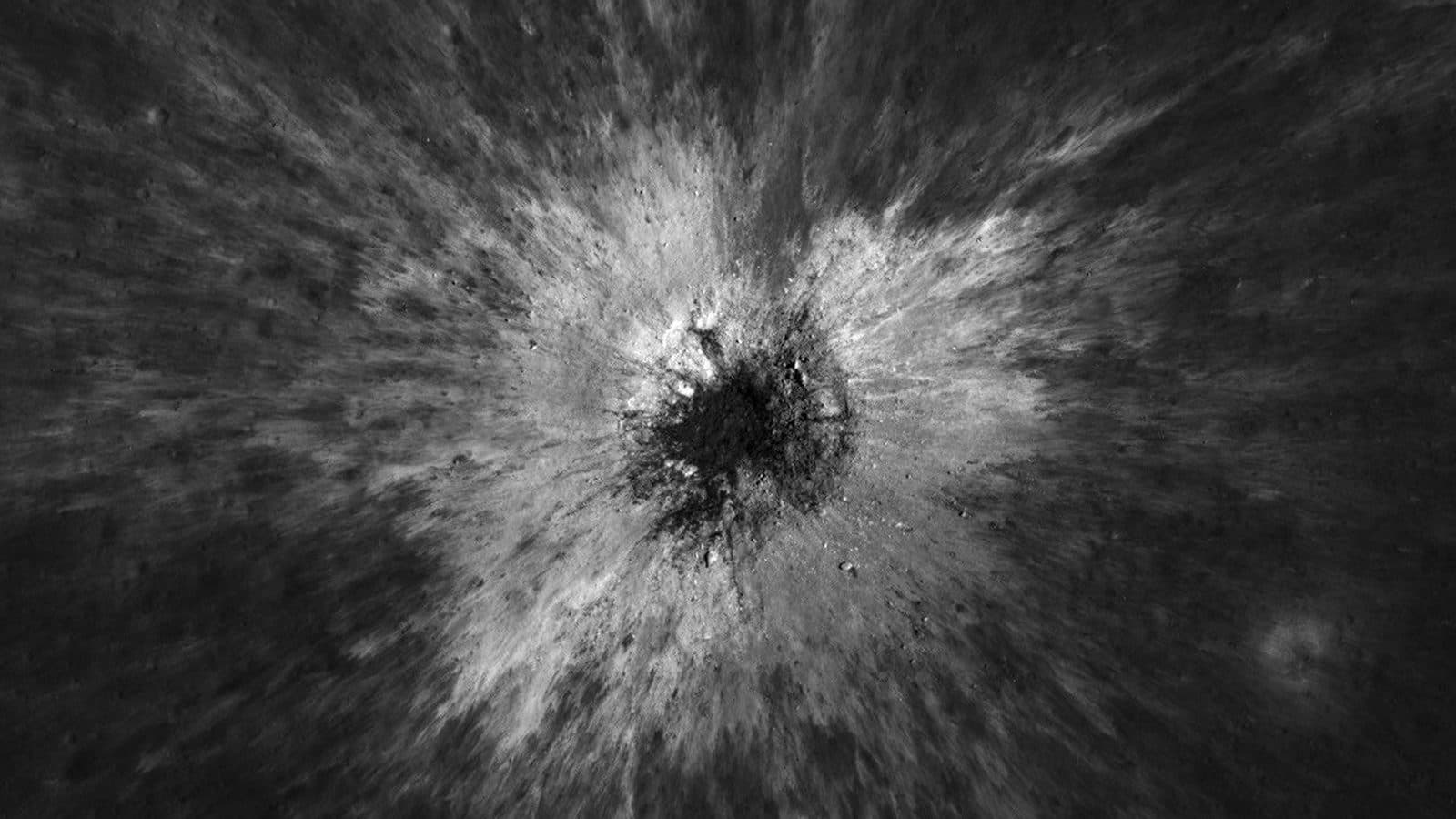
The crater, now named McGetchin, measures about 222 metres (728 feet) across and up to 43 metres (141 feet) deep. It formed on the Moon's eastern edge, near the border between dark volcanic plains and brighter highland crust, sometime between April 11 and May 22, 2024. The object that carved it was likely a fragment of an asteroid or comet roughly the size of a three- to six-story building.
The name honors Thomas McGetchin, a volcanologist and lunar scientist who helped shape the modern understanding of how impact ejecta spreads across a landscape. The International Astronomical Union adopted it on May 4, 2026, on a proposal from the LROC team, and the 1973 framework McGetchin developed for ejecta deposits is still a reference point for reading craters. The crater that now carries his name is testing parts of that framework.
Not seen in real time: No telescope watched the McGetchin impact happen. The crater was found by comparing images taken years apart, so scientists can bracket its formation date but cannot pin it to a single day or hour.
A crater that appeared between two sets of images
Finding a new crater on the Moon is usually a job of subtraction. LROC's Wide-Angle Camera (WAC) photographs broad swaths of the surface with pixels the size of football fields. When the team stacks hundreds of frames taken months or years apart and compares them, anything unchanged turns gray while anything new shows up as a bright or dark patch.
Wagner was reviewing one of those temporal-ratio maps when the McGetchin signature appeared: a white spot, made by freshly thrown ejecta, inside a darker halo of disturbed ground. "It was by far the most obvious impact debris pattern I've ever seen in one of these images," he said.
The software that builds those maps flags every small shift in lighting or shadow, producing hundreds of false alarms, so the LROC team still checks candidates by eye. A real crater often shows up as a small, fuzzy halo around a pixel-wide bright point, the signature of regolith splashed out by an impact.
Once the site was identified, the team turned to LRO's Narrow-Angle Camera (NAC), which images at roughly 3 feet (about 1 metre) per pixel. LROC had taken pictures of that spot before the impact but none after, so the cameras were re-pointed at the location during passes over the following months. The first overhead close-up of McGetchin used here was captured on Dec. 5, 2025, and it showed the crater's size, its shape and the way the surrounding terrain had been rearranged.
That before-and-after pairing is a large part of why the discovery matters. Most craters studied on the Moon are ancient, their original surfaces worn down by billions of years of further impacts and space weathering. McGetchin is young enough that its fresh morphology, ejecta blanket and interior detail remain intact, giving scientists a rare natural test of how cratering works.
A cold spot miles wide
LRO carries more than cameras. Its Diviner instrument measures surface temperature, and after the discovery the Diviner team re-examined the site. It found a cold spot roughly 4 miles (about 7 kilometres) wide around the crater, where nighttime temperatures run about 16 degrees Fahrenheit (8 to 9 kelvin) below the surrounding landscape.
That cooling is a consequence of what the impact did to the regolith, the loose layer of dust and broken rock that covers the Moon. The blast decompacted the upper surface, fluffing it up and making it less dense, so it holds heat poorly after sunset. The result is a thermal fingerprint that fades over hundreds of thousands to a million years, which makes cold spots a useful way to find young craters.
The Diviner analysis, led by Tyler M. Powell, examined 21 newly formed craters larger than 20 metres and found that every one wider than about 30 metres produced a detectable cold spot, with larger craters creating stronger anomalies. Because McGetchin sits on the contact between two very different rock types, its cold spot offered a natural experiment: the anomaly stretched across both mare and highland terrain and was strikingly symmetrical, suggesting the top few centimetres of regolith behave similarly no matter what lies beneath.
LRO was not built to record seismic waves, but the event also points to the Moon's activity beneath the surface. Large impacts release energy as ground motion, and connecting an observed crater to the shaking it produced is part of how scientists build a picture of the lunar subsurface.
Disturbance far beyond the rim
The second surprise was how far the impact's effects reached. The study led by Mark S. Robinson, the LROC principal investigator at Intuitive Machines, reports surface modification extending more than 1,000 crater radii from the impact point, and the LROC team detected reflectance changes more than 100 kilometres away.
Those distant marks are not piles of debris hurled from the hole. The impact appears to have changed the texture of the surface across a vast area, reshaping material well beyond the continuous ejecta blanket that surrounds the rim. The LROC team also found evidence that the high-speed jetting of material off the surface happened at steeper angles than models had assumed, above 10 degrees rather than the roughly 2 degrees previously considered typical, and that the ejecta was deposited in at least two flows.
Scientists say that kind of detail is exactly what a well-imaged fresh crater provides: a check on models describing everything from first contact to the collapse of the crater walls. McGetchin's measured dimensions, a 222-metre average diameter, a 43-metre depth, wall slopes averaging 24 degrees and a rim about 8 metres high, line up closely with existing models, the LROC team reported.
Why a single fresh crater matters
Impact rates are one reason. The Moon has no atmosphere to burn up incoming objects, so its surface is a long-running record of collisions. LRO has identified at least 1,000 new impact craters over more than 17 years and flagged about 100,000 other surface changes. Scientists estimate that impacts large enough to leave a crater about 30 feet wide happen roughly 140 times a year across the Moon, though most are too small to spot from orbit.
McGetchin is a different order of event. Models predict a crater of its size forms about once every 132 years on the Moon, which is why NASA and the papers call it a once-in-a-century find. Before this discovery, the largest fresh crater identified during the LRO mission was about 70 metres across, less than a third of McGetchin's diameter.
Fresh craters also help calibrate how scientists date surfaces. Planetary scientists estimate the age of a landscape by counting craters, on the logic that more craters means an older surface. That method depends on knowing the rate at which new ones appear, and a dated crater of known size is a direct measurement of that rate.
The findings carry a practical dimension for exploration as well. NASA frames the discovery in the context of its push for a sustained human presence on the Moon under Artemis. A 2024 impact that excavated rock and soil and disturbed the regolith far beyond its rim is a reminder that the lunar surface is an active environment. The material thrown outward, and the loosened ground left behind, could affect how rover wheels grip the surface and how equipment and habitats are designed to withstand high-speed particles arriving from distant impacts.
For planners, the rare large strike is not the only hazard. Smaller particles thrown outward at high speed can damage hardware, and the McGetchin event suggests those particles can travel farther and arrive at steeper angles than older models assumed. That is a design input for landers, rovers and, eventually, habitats.
LROC's ability to find McGetchin at all rests on repetition. The camera system has returned images of the Moon for more than 17 years, building an archive detailed enough to isolate a single new feature on a surface hundreds of miles wide, the scale of the global map Wagner was reviewing. That archive is the reason a 2024 impact could be identified at all, and it is why NASA treats the long-running mission as infrastructure for future lunar work rather than a one-off survey.
What the discovery does not show
The "largest ever identified" label is a statement about the record, not the universe. It means no larger freshly formed crater has been found since scientists began comparing lunar images, not that impacts of this size are unprecedented in the solar system's history. Likewise, the once-in-a-century estimate comes from crater-population models rather than from watching many such events.
Some details remain open. Researchers expect a future paper to estimate the size and force of the impactor, and the work of translating one well-studied crater into better predictions will continue. For now, McGetchin offers something rare: a clear, dated mark left on another world in an era when humans were watching closely enough to notice it.
A future mission could study the site up close. For the teams behind LRO, which launched in 2009 and has now been mapping the Moon for more than 17 years, the crater is also a validation of the long, patient business of taking the same pictures again and again and looking carefully at what changed.
Credit: Cover image of McGetchin crater from NASA's Lunar Reconnaissance Orbiter Narrow-Angle Camera (Dec. 5, 2025). Credit: NASA/Goddard Space Flight Center/Intuitive Machines. NASA imagery is generally not subject to copyright in the United States.
Tags
Frequently asked questions
- What is McGetchin crater?
- McGetchin is a fresh impact crater on the Moon's eastern edge, about 222 metres (728 feet) wide and up to 43 metres (141 feet) deep. It formed between April 11 and May 22, 2024, and is named after lunar scientist Thomas McGetchin.
- How was the new Moon crater discovered?
- NASA's Lunar Reconnaissance Orbiter spotted it on Oct. 24, 2025, when image specialist Robert Wagner compared Wide-Angle Camera images taken years apart and found a bright spot ringed by a dark halo. Sharper Narrow-Angle Camera images taken from Dec. 5, 2025 confirmed its size and shape.
- Why does the new lunar crater matter?
- Fresh craters let scientists measure how often impacts occur, test models of crater formation, and study how one collision reshapes the surface far beyond its rim. The findings also inform how equipment might cope with the Moon's active surface.
- Is McGetchin the largest crater on the Moon?
- No. NASA and the study authors describe it as the largest newly formed crater ever identified in the solar system. The Moon's biggest impact basins are thousands of kilometres across and formed billions of years ago.

TPW Editorial
Editorial Team
TechPastWeek's editorial team reports and edits every story we publish. We research each piece against primary and credible secondary sources, and a human editor reviews and signs off before it goes live.