Rocket Lab’s 96th Electron Lofts a 12th StriX Radar Satellite for Synspective
Rocket Lab launched its 96th Electron on September 19, 2026, carrying a 12th StriX radar satellite for Synspective and extending a 100% success record.

On this page
Key takeaways
- Rocket Lab launched its 96th Electron mission, named “Owl By The Dozen,” from Launch Complex 1 in Mahia, New Zealand, at 3:22 p.m. NZST on September 19, 2026 (0322 UTC September 19; 11:22 p.m. EDT September 18).
- The flight deployed Synspective’s 12th StriX synthetic-aperture-radar satellite into a 572-kilometre low Earth orbit and extended Rocket Lab’s 100% mission-success record across all Synspective launches.
- Rocket Lab has been Synspective’s sole launch provider since 2020, and the company says 15 more dedicated Electron missions for the Japanese constellation are booked through the end of the decade.
- The mission was Rocket Lab’s 17th Electron launch of 2026 and its fifth in roughly six weeks, a cadence the company markets as a selling point for small-satellite operators.
- Rocket Lab said on September 11 that it filed a protest of NASA’s $700 million Mars communications-orbiter award to Blue Origin, and SpaceNews reported on September 17 that its $8 billion Iridium acquisition is on track to close by mid-2027.
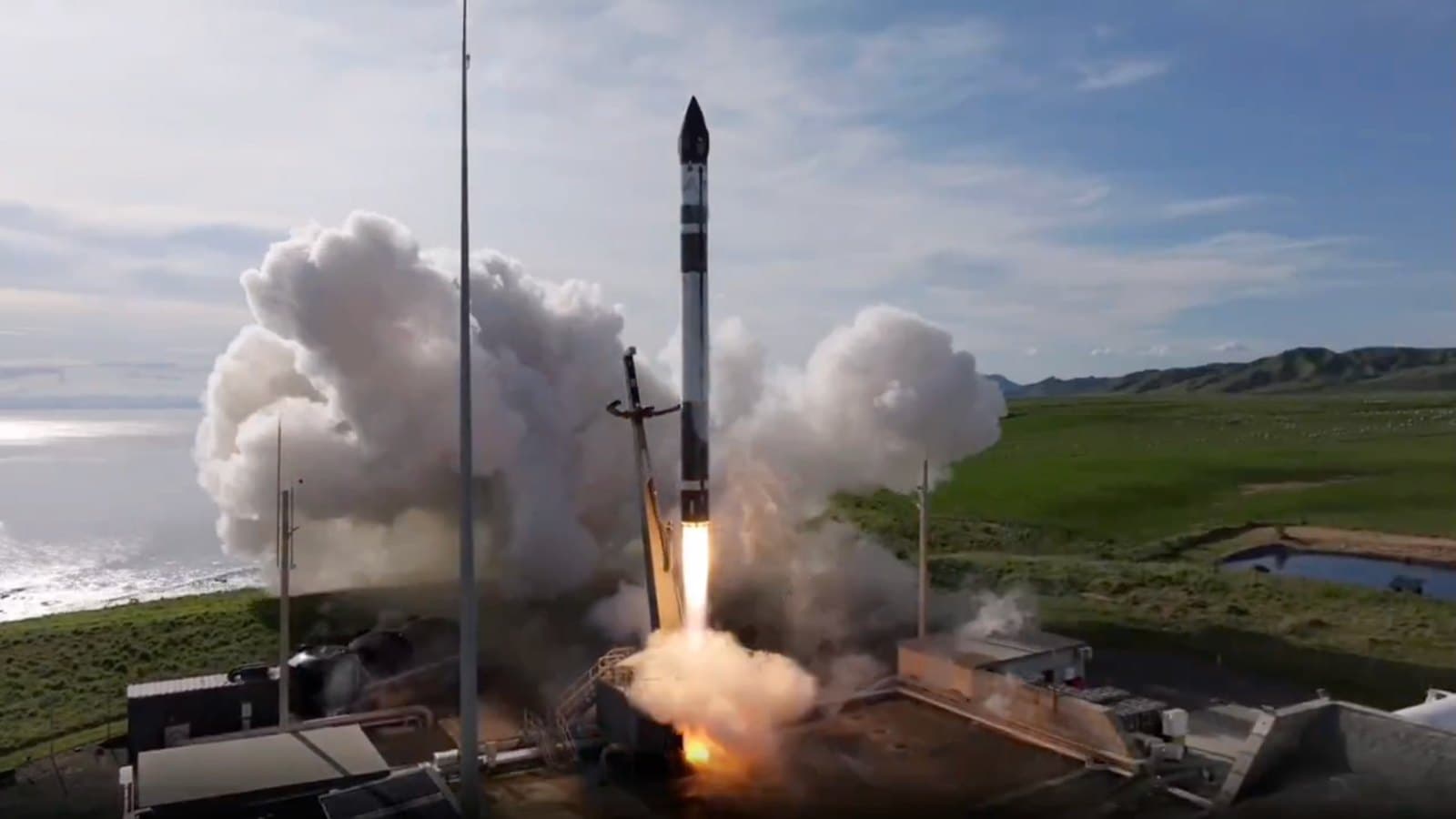
Rocket Lab launched its 96th Electron rocket on September 19, 2026, placing the 12th StriX synthetic-aperture-radar satellite into a 572-kilometre orbit for the Tokyo-based Earth-observation company Synspective. The mission, named “Owl By The Dozen,” lifted off from Launch Complex 1 on New Zealand’s Mahia Peninsula at 3:22 p.m. NZST, which converts to 0322 UTC on September 19 and 11:22 p.m. EDT on September 18.
Related reading: NASA Asks Industry Whether Commercial Spacecraft Could Boost or Retire Hubble · Japan Launches MMX to Bring Back a Piece of Phobos.
That time-zone split matters for anyone reconciling headlines. SpaceNews dated the launch to September 18 and its photo caption specifies “Sept. 18 (U.S. time).” Space.com described the same liftoff as occurring “at 11:22 p.m. ET tonight (Sept. 18).” Rocket Lab’s own release, the mission page and Synspective’s schedule notice all use September 19, the New Zealand and UTC calendar date. None of the reports disagree about the moment; they disagree about which clock to print.
Sorting out the mission number
The flight is Rocket Lab’s 96th Electron mission. That figure appears in the company’s “Owl By The Dozen” mission page, in its September 19 GlobeNewswire release and in independent coverage from Space.com and the Foreign Policy Journal.
It is worth being precise about why 96 is the right number, because Rocket Lab’s own releases can look contradictory at a glance. A September 2 release described that day’s Synspective flight, “Owl Around The World,” as the 94th Electron mission. Between that launch and mid-September the company flew once more: a confidential commercial payload on September 11, which Rocket Lab logged as its 95th mission, “Happily Ever Faster.” The sequence runs 94th on September 2, 95th on September 11 and 96th on September 18 (U.S. time) or 19 (New Zealand time). There is no missing flight and no contradiction, only a numbering gap that a two-week cadence filled in.
The payload itself was Synspective’s 12th StriX satellite, carried to a 572-kilometre orbit at 38 degrees of inclination. Rocket Lab’s Kick Stage performed the final orbital placement, which the company says was accurate enough to maximize the satellite’s on-orbit lifetime and allow it to be integrated into the constellation quickly. As on earlier StriX flights, Rocket Lab supplied a custom payload fairing sized to the satellite’s dimensions.
Five flights in roughly six weeks
SpaceNews framed the launch as the fifth time Electron had flown in about a month and a half. Counting backward from September 19, the run includes an August 6 mission for the Japanese constellation company iQPS, the 93rd Electron flight for iQPS on August 20, “Owl Around The World” on September 2, “Happily Ever Faster” on September 11 and “Owl By The Dozen” itself. Rocket Lab’s marketing leans into the pace: with 17 launches completed in 2026, it calls Electron “the world’s most frequently launched small-lift orbital rocket.”
That claim is a category statement, not an absolute one. Electron is not competing with SpaceX’s Falcon 9, which flies far more often at a much larger scale, nor with rideshare aggregators that bundle many small satellites onto a single medium-lift rocket. It competes in the dedicated small-lift lane, where an operator buys the whole rocket and chooses the orbit. In that lane, a steady drumbeat of flights is the product as much as the vehicle is.
Understanding the cadence claim helps here. Electron is a small, two-stage rocket about 18 metres tall that uses electric-pump-fed Rutherford engines and a carbon-composite airframe, and it can place roughly 300 kilograms into low Earth orbit. That is a fraction of what a medium-lift vehicle carries, which is exactly the point: a dedicated small rocket can send one satellite to a bespoke orbit without waiting for a rideshare to fill up. The vehicle has flown since 2017, when Rocket Lab began launching from the same Mahia Peninsula site, and it has accumulated the 96 missions that now define its record.
Electron’s cadence has become one of Rocket Lab’s more effective sales arguments. A small-satellite operator weighing a dedicated launch is buying schedule certainty as much as payload capacity, since a constellation only generates revenue once enough satellites are on orbit. Rocket Lab says its next Electron mission, “Owlright, Owlright, Owlright,” is targeted for no earlier than September 26 from Launch Complex 1 Pad B, again for Synspective. That would be the 13th of what the company has described as 27 dedicated Electron launches planned to complete the constellation by 2030.
The dedicated small-lift market is thinner than it looks. A handful of vehicles can carry the class of payload Electron handles, and several have struggled to reach a dependable rhythm. That scarcity cuts both ways for Rocket Lab: it makes reliability and frequency a genuine differentiator, and it means a launch failure would be felt across many customers at once, including a Synspective manifest that spans the rest of the decade.
Why Synspective keeps flying Electron
Synspective is the clearest example of the cadence strategy working. The company builds and operates a constellation of synthetic-aperture-radar satellites, which image the Earth’s surface using radar pulses rather than visible light. That lets them collect data at night and through cloud cover, an advantage for the land-displacement, flood-damage and infrastructure-monitoring products Synspective sells.
The appeal of radar imaging is that it does not depend on sunlight or clear weather. A synthetic-aperture-radar satellite sends out microwave pulses and measures the returns, building a picture of the ground that is available day or night, which makes the data useful for tracking slow ground movement, mapping floods and assessing damage after an earthquake. Synspective sells those observations as subscription-style monitoring products to customers in construction, infrastructure and disaster response, mainly in Japan and increasingly abroad.
The constellation is named StriX, after a genus of owls, which explains the bird-themed mission names Rocket Lab has attached to the flights. Rocket Lab has served as Synspective’s sole launch provider since 2020 and has now flown 12 dedicated missions for the company. Across that entire relationship, Rocket Lab says, it has a 100% mission-success record. The September 19 flight extended it.
The companies have not disclosed the value of the launch contract. What is public is the pipeline: Rocket Lab’s September 19 release states that 15 additional dedicated Electron missions are manifested through the end of the decade. Its September 2 release, issued before the latest flight, said “another 16 missions” were booked, which is consistent with one having launched since. A separate account of the launch put the total planned Synspective manifest at 27 Electron launches by 2030, a figure that lines up with the earlier “another 18 missions” language in Rocket Lab’s May 2026 release for the ninth StriX flight.
For Rocket Lab, that is a durable, repeat customer whose satellites fit Electron’s lift capacity almost exactly. For Synspective, it is a launch arrangement that avoids the schedule uncertainty of rideshare, where a single delay can ripple across many customers. The relationship has lasted six years precisely because both sides get something the open market handles poorly: predictable, dedicated slots to a specific orbit.
The rest of the company, briefly
The launch happened during a busy stretch for Rocket Lab off the pad as well. On September 11 the company said it filed a protest of NASA’s decision to award a $700 million Mars communications-orbiter contract to Blue Origin, arguing that its own proposal should have won. The protest, reported by SpaceNews on September 12, is a rare public challenge by Rocket Lab to a NASA award and highlights how far the company has moved beyond launch into spacecraft and systems.
Days later, SpaceNews reported on September 17 that Rocket Lab expects to close its $8 billion acquisition of the satellite-communications operator Iridium by the second quarter of 2027, a deal that would fold a working satellite network and its spectrum into the company. Rocket Lab had moved to fully fund the purchase in mid-September. None of that changes the launch business, but it frames why a 96th Electron flight reads differently now than it would have a few years ago: the rocket is increasingly the front door to a much larger company.
The medium-lift future is also in view. Rocket Lab continues to develop Neutron, a larger, partially reusable rocket intended to carry far heavier payloads than Electron. The company has said Neutron’s first flight could come late this year or in early 2027. Until it does, Electron remains the vehicle that reliably flies and pays the bills, and its launch count is the metric the company most wants watched.
What to watch
Three things follow from this launch. The first is whether the next Synspective flight holds its late-September target, since another quick turnaround would reinforce the cadence claim. The second is the Synspective manifest itself: 15 more Electron missions is a large, multi-year commitment, and hitting it on schedule depends on Electron maintaining both its tempo and its reliability record. The third is Neutron. A successful debut would move Rocket Lab up into a different weight class, while a slip would leave the company leaning on Electron for longer.
For now, the story of mid-September is simpler than the strategic picture around it: a small rocket, launched 96 times, carrying a satellite built to see through clouds, on a schedule that has become the point.
Image: Rocket Lab / Space.com, official launch photograph distributed for press coverage of the “Owl By The Dozen” mission.
Tags
Frequently asked questions
- What was Rocket Lab’s 96th Electron mission?
- It was “Owl By The Dozen,” a dedicated flight for the Japanese radar company Synspective that launched from Launch Complex 1 in Mahia, New Zealand, on September 19, 2026 and deployed the 12th StriX satellite to a 572-kilometre orbit.
- When did the Owl By The Dozen launch happen?
- Liftoff was at 3:22 p.m. NZST on September 19, 2026, which is 0322 UTC on September 19 and 11:22 p.m. EDT on September 18. SpaceNews dated the flight to September 18 because it used U.S. time; Rocket Lab and Synspective use the New Zealand date.
- How many Electron launches has Rocket Lab flown for Synspective?
- The September 19 mission was Rocket Lab’s 12th dedicated StriX launch since 2020. The company says 15 more dedicated Electron missions are manifested to finish the constellation before 2030.
- How many times did Electron fly in 2026?
- The Owl By The Dozen mission was Rocket Lab’s 17th Electron launch of 2026 and the 96th in the rocket’s history, according to the company.

TPW Editorial
Editorial Team
TechPastWeek's editorial team reports and edits every story we publish. We research each piece against primary and credible secondary sources, and a human editor reviews and signs off before it goes live.