Orbital Debris and Space Traffic Management, Explained
Orbital debris is a long-lived by-product of spaceflight. Here's how it forms, how satellites steer clear of it, and why cleanup and governance remain hard.

On this page
Earth's orbital neighbourhood is the strangest commons humanity has ever used. It renews itself almost not at all, it has no fences, and every discarded object keeps moving at kilometres per second for decades or centuries. That combination (a shared resource, a long memory, and enormous kinetic energy) is what makes orbital debris both an engineering problem and a governance one.
Related reading: Google Is Sending Four TPUs to Orbit in Its First Suncatcher Test · The US Confirms It Has Weapons in Orbit, Ending Decades of Ambiguity.
This is a conceptual explainer: what the different orbits actually do, how debris accumulates, how operators track and dodge it, and why the rules remain so difficult to enforce.
The orbital regimes, and why altitude is destiny
The first thing to understand is that "orbit" is not one place. The relevant physical variable is atmospheric drag, and drag falls off so steeply with altitude that a few hundred kilometres changes the timescale of the problem from years to millennia.
- Low Earth orbit (LEO), roughly 200–2,000 km. Home to the International Space Station, Earth-observation fleets, and the large broadband constellations. Below about 600 km, residual atmosphere drags objects down within years; near 800 km, decay takes centuries. NASA's Orbital Debris Program Office notes that debris below 600 km normally reenters within several years, at 800 km on the order of centuries, and above 1,000 km for a thousand years or more (NASA ODPO).
- Medium Earth orbit (MEO), roughly 2,000 km to geosynchronous altitude. The navigation constellations (GPS, Galileo, GLONASS, BeiDou) live near 20,000 km. Drag is negligible, so fragmentation there is effectively permanent, and low density does not make a collision cheap.
- Geostationary orbit (GEO), 35,786 km above the equator. A single crowded ring where satellites appear fixed over one point. There is no drag to clear it. Operators therefore move retired spacecraft a few hundred kilometres higher into a "graveyard" or disposal orbit, a practice that has been comparatively well followed (Swiss Re).
REGIME   ALTITUDE           NATURAL CLEARING   DEBRIS BEHAVIOUR
LEO      200-2,000 km       strong (lower)     Years below ~600 km; centuries near 800 km
MEO      ~2,000-35,786 km   negligible         Millennia-scale persistence; low density
GEO      35,786 km          none               No clearing; graveyard orbit ~+300 km
The Inter-Agency Space Debris Coordination Committee (IADC) treats LEO and GEO as the two "protected regions," precisely because they are the most valuable and the most fragile.
How debris is created
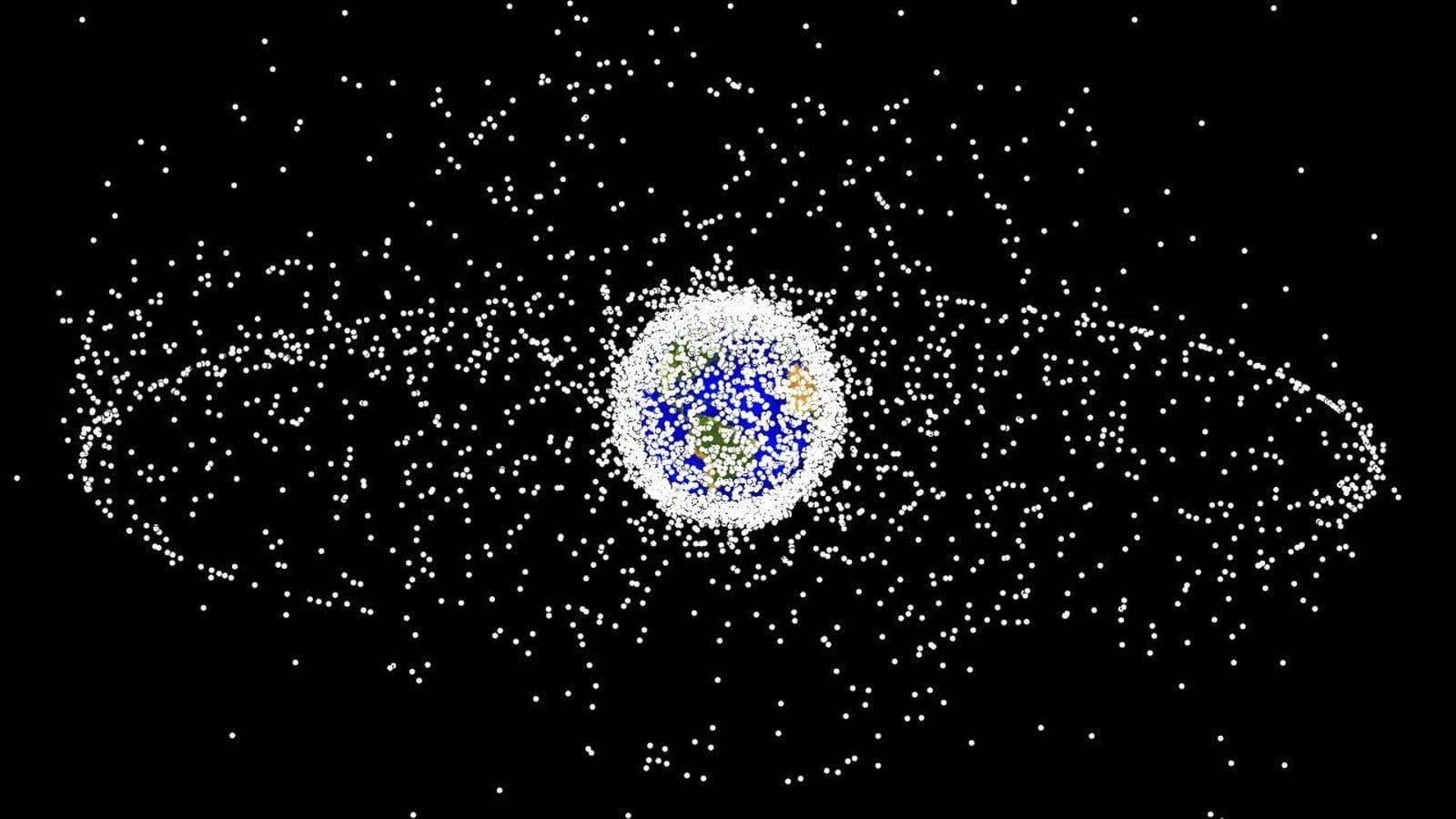
The popular image is of a satellite blowing up. In practice, most tracked debris comes from things that have already stopped working. ESA's Space Debris Office counts more than 650 break-ups, explosions, collisions, or anomalous fragmentation events, and its statistics put the current tracked population at roughly 44,870 objects, with model-based estimates of about 54,000 objects larger than 10 cm, 1.2 million between 1 cm and 10 cm, and 140 million between 1 mm and 1 cm (ESA Space Environment Statistics). Only a minority of tracked objects are working satellites.
Four mechanisms do most of the damage:
- Collisions. The worst accidental case was an operational Iridium communications satellite and a derelict Russian Cosmos spacecraft, which met at orbital speed and generated a large, persistent debris cloud (NASA ODPO).
- Anti-satellite tests (ASATs). A Chinese intercept of its Fengyun-1C weather satellite added more than 3,300 trackable objects, increasing the catalogue by a quarter in a single event, and its fragments still drive close approaches in Sun-synchronous orbits (ESA Space Debris FAQ). Russia's destruction of Cosmos 1408 produced at least 1,500 trackable fragments and briefly forced space-station crews to shelter (NASA NTRS; BBC). India's Mission Shakti test created fewer trackable fragments because it occurred at a lower altitude, where drag clears debris faster.
- Explosions from stored energy. Retired rocket upper stages and spacecraft can rupture because of leftover propellant, batteries, or pressurised tanks, which is why "passivation" (draining and safing those systems at end of life) matters so much.
- Operational release and degradation. Paint flecks, lens caps, and slag from solid rocket motors add to the small-particle population, but the mass and the collision risk are dominated by the large intact objects.
The cascading logic is named after NASA scientist Donald Kessler. His insight was that beyond a certain density, collisions produce fragments faster than natural drag removes them, and those fragments collide with other large objects in turn. ESA's long-term simulations suggest fragments would come to dominate in the 800–1,400 km band even if all launches stopped today, and that this holds because existing mass keeps colliding (ESA Space Debris FAQ).
The part that surprises people
The debris problem is not only about adding new objects. Even in a no-further-launch scenario, the amount of debris in LEO keeps rising, because the large abandoned satellites and rocket bodies already up there continue to fragment and collide. Mitigation slows the growth; only removing mass from orbit can bend the curve.
At orbital speeds the energy is the point: objects in LEO travel at about 7–8 km/s, and the average collision speed is roughly 10 km/s, up to about 15 km/s (NASA ODPO). A 1 cm fragment can disable a spacecraft; a 10 cm object can shatter it.
How objects are tracked, and how satellites dodge
Tracking is a radar-and-telescope business. Ground-based sensors can routinely follow objects larger than about 5–10 cm in low orbit and larger than roughly 0.3–1 m at GEO, and can detect smaller objects down to about a centimetre without being able to predict their orbits well (ESA Space Debris FAQ). That gap is the core asymmetry: the objects large enough to do catastrophic damage are mostly catalogue-able, while the far more numerous centimetre-scale objects are, in practice, invisible bullets.
From the catalogue comes conjunction assessment, screening predicted trajectories for close approaches and computing a probability of collision. In the United States, the 18th Space Defense Squadron maintains the high-accuracy catalogue and issues conjunction data messages to operators worldwide; NASA's Conjunction Assessment Risk Analysis programme does the same for its own missions and publishes best practices (NASA CARA handbook). Public services such as CelesTrak's SOCRATES run the same kind of screen against the public catalogue and publish threatening encounters (CelesTrak).
When the risk crosses a threshold, the operator can manoeuvre. The thresholds vary: NASA's ISS rules trigger a manoeuvre when the chance of collision exceeds about 1 in 10,000 (NASA ODPO). ESA says its Earth-orbiting satellites perform on average about two collision-avoidance manoeuvres per satellite per year, with the Copernicus Sentinels manoeuvring roughly every three months (ESA Space Debris FAQ). Those manoeuvres cost fuel, which shortens mission life, and they interrupt operations.
Why dodging is harder than it sounds
A warning is only as good as the orbit prediction behind it. Two-line elements alone are not accurate enough for serious conjunction work; operators need precise ephemerides with realistic uncertainty. When two manoeuvrable satellites both plan to move, they have to coordinate so they do not manoeuvre into each other. Most of the difficulty in space traffic management is coordination, not physics.
Megaconstellations: traffic and the night sky
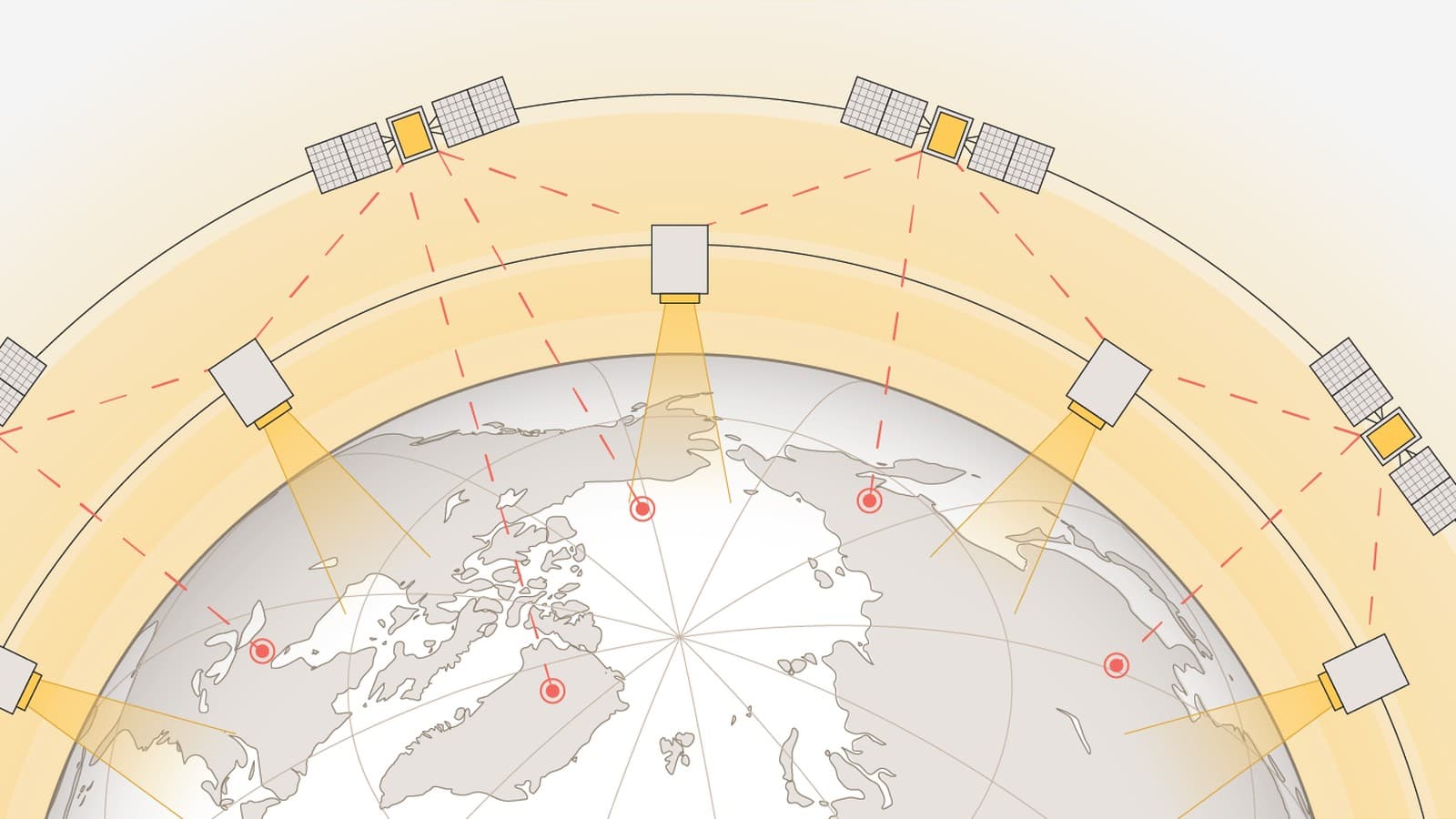
The scale of the traffic problem changed with the broadband constellations. Instead of a few hundred large satellites, operators are deploying thousands of small ones in shells, with tens of thousands more planned across multiple companies and countries. ESA's figures count roughly 14,200 functioning satellites already, out of about 16,910 still in space (ESA Space Environment Statistics).
Two consequences follow. The first is traffic: more objects, more conjunctions, more manoeuvres, and a screening workload that grows faster than the catalog. The second is the sky. As satellite numbers rise, bright satellites cross astronomical exposures and add diffuse artificial brightness to the night sky. The International Astronomical Union's Centre for the Protection of the Dark and Quiet Sky recommends that satellites in operational orbit should not be visible to the unaided eye, and sets a stricter brightness limit for interference with professional research (IAU). A study in Monthly Notices of the Royal Astronomical Society: Letters found that nearly all the major constellations it measured exceed that research limit, and most also exceed the unaided-eye limit (MNRAS Letters).
Operators have responded with darkening coatings, off-pointing solar arrays, and other design changes, and the trend for newer spacecraft is generally fainter. But "fainter" is not the same as "invisible," and the astronomy community argues that brightness should be treated as a design requirement rather than an afterthought.
As ESA's Space Debris Office puts it:
The orbits around Earth are – like the oceans, forests, land and food on Earth – a limited natural resource. We must use them responsibly, and protect them for future generations.
Mitigation: the rules on the books
Debris mitigation rests on a small set of ideas: do not release junk during normal operations, do not leave stored energy that can explode, remove spacecraft from protected regions at end of life, and avoid intentional destruction. The IADC's guidelines, which also fed the UN Committee on the Peaceful Uses of Outer Space (COPUOS) guidelines, are the international reference; they are technical consensus, not law (ESA Space Debris FAQ).
The headline number has tightened. For years the benchmark was to clear LEO within 25 years of end of mission. The U.S. Federal Communications Commission replaced that with a five-year rule for satellites ending their mission in, or passing through, LEO below 2,000 km and disposing by uncontrolled reentry (FCC). ESA similarly moved its own standard down to five years. The tight timeline matters because it shortens the window in which a dead satellite can become a collision partner.
Compliance is uneven, and the discrepancy is revealing. ESA reports that more than 80% of GEO satellites have been disposed of in line with guidelines, compared with only 15–30% at LEO, where active disposal is required and natural decay will not do the job (ESA Space Debris FAQ). GEO operators have made disposal routine partly because the orbit is so commercially valuable; LEO has many more operators and weaker enforcement.
The reliability number that actually matters
Studies cited by ESA find that containing debris growth needs disposal success of more than 90% for traditional satellites, and at least 95% for the large constellations of small satellites, because there are so many of them. A policy that works "most of the time" is not enough when the fleet is in the thousands.
Modern spacecraft are also expected to be manoeuvrable and passivated, and increasingly to be designed for demise, built so that they burn up more completely during reentry. Some designs add docking plates or markers so a future servicer can capture them. These are not optional niceties: they are what makes the difference between an object that can be handled and one that becomes permanent debris.
Cleanup: removing what is already there
Mitigation only limits new debris. To actually reduce the large-object population that drives cascading collisions, something has to take mass out of orbit. ESA states plainly that the number of objects in LEO can only be controlled by actively removing five to ten large objects (full defunct satellites or rocket bodies) per year (ESA Space Debris FAQ). That is the target for active debris removal (ADR).
The technology is moving from experiment to service. ESA commissioned the first debris-removal mission, ClearSpace-1, as a commercial service contract rather than a one-off procurement, explicitly to seed a market (ESA). Astroscale has flown rendezvous and inspection missions against a derelict upper stage and is developing the ELSA-M servicer and the UK-led COSMIC mission to remove inactive satellites, alongside plans for refuelling and life extension (Astroscale). On-orbit servicing and debris removal share most of the hard technology (autonomous rendezvous, capture, and disposal), which is why they are usually discussed together.
ADR faces a market problem before it faces an engineering one: removing someone else's abandoned hardware is a public good, so no single operator will pay what it costs. Making removal a licensing condition, or a paid service purchased by agencies or an industry fund, is the recurring policy proposal.
The economics and the insurance angle
Debris is a textbook negative externality: the operator that creates it captures the benefit of the mission, while the collision risk is spread across everyone else. Economists describe a possible "economic Kessler syndrome," in which orbits become unprofitable before they become physically unusable because insurance and operational costs rise faster than revenues (OECD).
Insurance is where that externality reaches operators directly. Space insurance typically covers launch and in-orbit failure, business interruption, and third-party liability, with liability cover for damage on Earth often a licensing requirement. Some states, including France and the United Kingdom, make third-party liability insurance mandatory (OECD). Insurers have long warned that debris raises the risk of high-value losses and that attribution is difficult (Swiss Re).
Attribution is the crux: even when a collision is detected, proving whose object caused it is hard, especially for small debris. That uncertainty makes both underwriting and liability enforcement expensive, and helps explain why insurance alone is not a sufficient deterrent.
Governance: who enforces what
The legal foundation is the Outer Space Treaty, which makes states responsible for national space activities whether carried out by governments or private companies, and liable for damage caused by their space objects (UNOOSA). Under that framework, a state is expected to authorise and continuously supervise its operators, and the Liability and Registration Conventions give the system its hooks.
Beyond that, enforcement is fragmented:
- No treaty specifically regulates debris. There is no binding international instrument on orbital debris; the UN COPUOS guidelines and the IADC guidelines are voluntary (NASA ODPO).
- Technical consensus is not law. IADC coordinates the world's major space agencies, but its guidelines only bite when a state writes them into licensing.
- National regulators do the enforcing. The FCC conditions U.S. radio licences (and hence most commercial LEO satellites that serve the U.S. market), while the FAA and NOAA handle launch and remote-sensing licensing (NASA ODPO). France, the United Kingdom, and several other states impose their own mitigation requirements on operators they license.
- The ITU handles spectrum and slots, not debris. Its coordination role shapes who can operate where, but its mandate is interference, not collision risk.
- Flag-state shopping is a real loophole. An operator can register a constellation through a state with lighter rules, which is exactly why the astronomy and sustainability communities push for common minimum standards.
The result is a system where the physics is global, the satellites are commercial, and the authority is national, a mismatch that no amount of good engineering can resolve on its own.
Caveats
A few honest limits. The debris population numbers are estimates from models, not a direct census; the smallest fragments are inferred rather than observed, and the catalogue is incomplete and sometimes stale. Conjunction warnings are probabilistic, so operators routinely deal with false alarms and missed detections. Brightness measurements are a young and partly contested field, and the economics of active debris removal remains largely speculative, because the willingness to pay is a policy choice rather than a market outcome. Finally, historical fragmentation totals and compliance rates are revised as tracking improves.
What to watch
The durable questions are less about any single event than about whether the system changes behaviour:
- Do five-year disposal rules actually improve compliance, and do constellation operators hit the ~95% disposal reliability that simulations say is needed?
- Does active debris removal scale from one-off demonstration missions to a recurring service, and who pays?
- Do brightness standards become design requirements, with measurement and reporting that astronomers can verify?
- Can operators coordinate as traffic rises, potentially through automated conjunction handling and shared ephemerides?
- Will states act on ASAT norms, given that destructive tests are the single most damaging source of long-lived debris?
None of these has a clean answer yet. What is clear is that orbit is a resource with a very long memory, and the decisions made about design, disposal, and enforcement compound for centuries.
Cover image: NASA Orbital Debris Program Office, a computer-generated plot of tracked objects in Earth orbit (public domain).
Tags

TPW Editorial
Editorial Team
TechPastWeek's editorial team reports and edits every story we publish. We research each piece against primary and credible secondary sources, and a human editor reviews and signs off before it goes live.