How Reusable Rockets Fly Again: The Engineering of Booster Landings
Staging throws away a rocket's most expensive part. Here is how Falcon 9 boosters land themselves, and why propulsive reuse changed launch economics forever.

On this page
Key takeaways
- A Falcon 9 first stage returns from space with up to three engine burns: a boostback burn, an atmospheric entry burn, and a single-engine landing burn.
- The landing is a hoverslam, because even at minimum throttle a single Merlin engine produces more thrust than the nearly empty booster weighs, so the stage cannot hover.
- SpaceX flew a record 165 Falcon 9 orbital missions in 2025, and had recorded more than 650 Falcon booster landings by August 2026.
- The first stage is the most expensive part of the rocket, which is why recovering it is the core economic case for reuse.
- Competitors are closing in: Blue Origin landed New Glenn in November 2025, and China recovered a Zhuque-3 first stage on land in August 2026.
For most of the space age, a rocket was a disposable object. It threw a payload toward orbit, then fell back and burned up or hit the ocean, ending every flight with its most complicated machinery deliberately destroyed. By the mid-2020s, SpaceX was routinely bringing the largest and most expensive piece of its rockets back from the edge of space to land upright on a concrete pad or a robot barge.
Related reading: SpaceX Launches CRS-35 With the Final Pair of ISS Roll-Out Solar Arrays · SpaceX Flies 700th Falcon Mission, Completing SES's O3b mPOWER Constellation.
This is not a story about one launch. It is about the engineering that makes a booster landing possible and the economics that make it worth attempting.
Why rockets are built in stages
A single-stage rocket carrying enough propellant to reach orbit would be almost entirely tank. The rocket equation punishes every kilogram that is not propellant, so engineers split the vehicle into stages and throw the lower ones away. The first stage does the heavy work of lifting the stack through the thick lower atmosphere, then separates and falls back, letting a much smaller upper stage finish the job.
That layout is efficient, and for decades it was also wasteful. The first stage is the biggest and most engine-dense part of the rocket. SpaceX founder Elon Musk has put it at roughly 70 to 75 percent of the vehicle's cost. The second stage is smaller and simpler. The propellant is cheap: filling a Falcon 9 with kerosene and liquid oxygen costs on the order of a few hundred thousand dollars, a rounding error next to the hardware.
That asymmetry is the whole argument for reuse. If the expensive part can be recovered and flown again, the next launch costs refurbishment and fuel rather than a new booster. The catch is that recovering it means undoing the velocity the rocket just built.
The three burns of a Falcon 9 landing
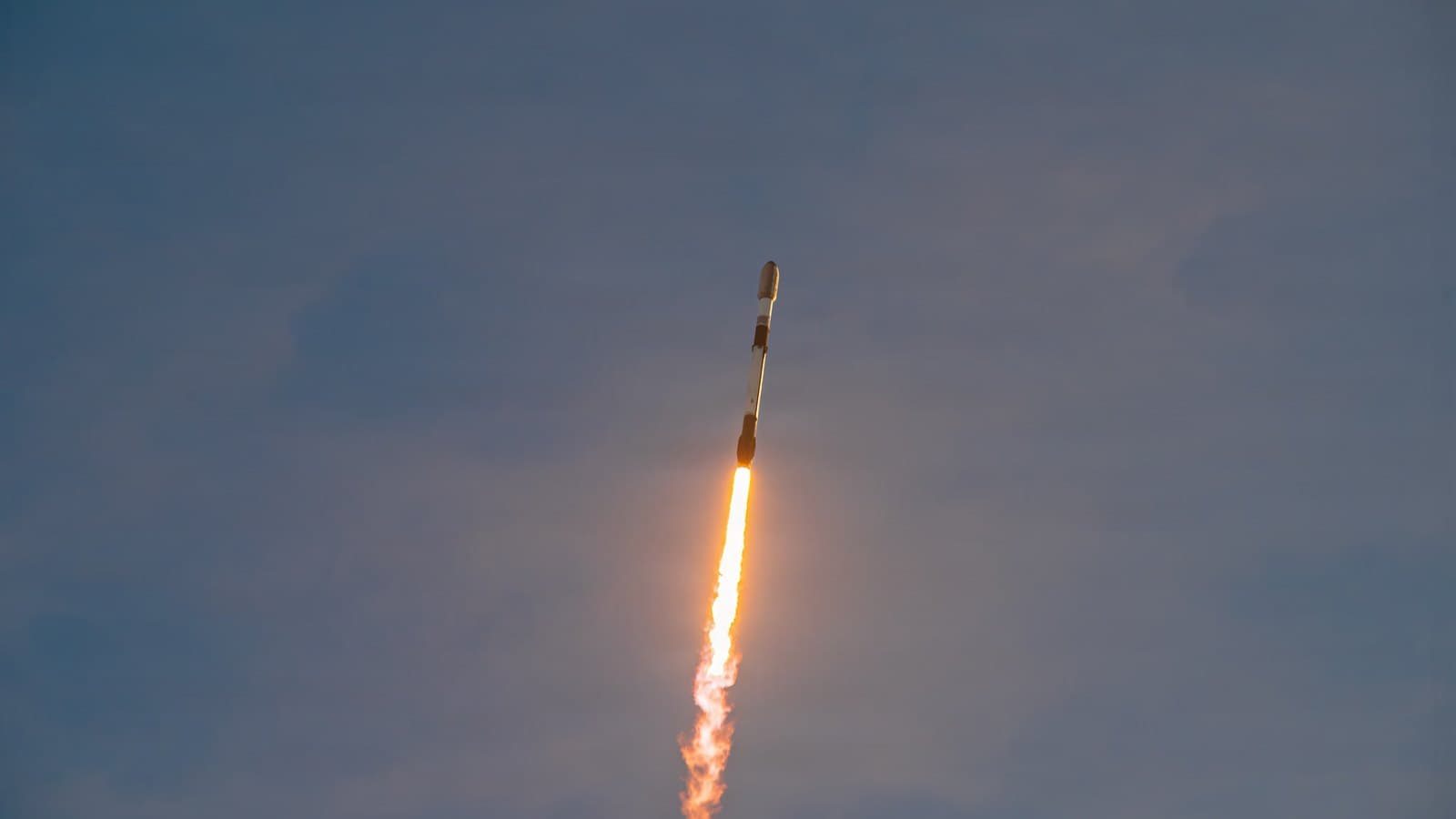
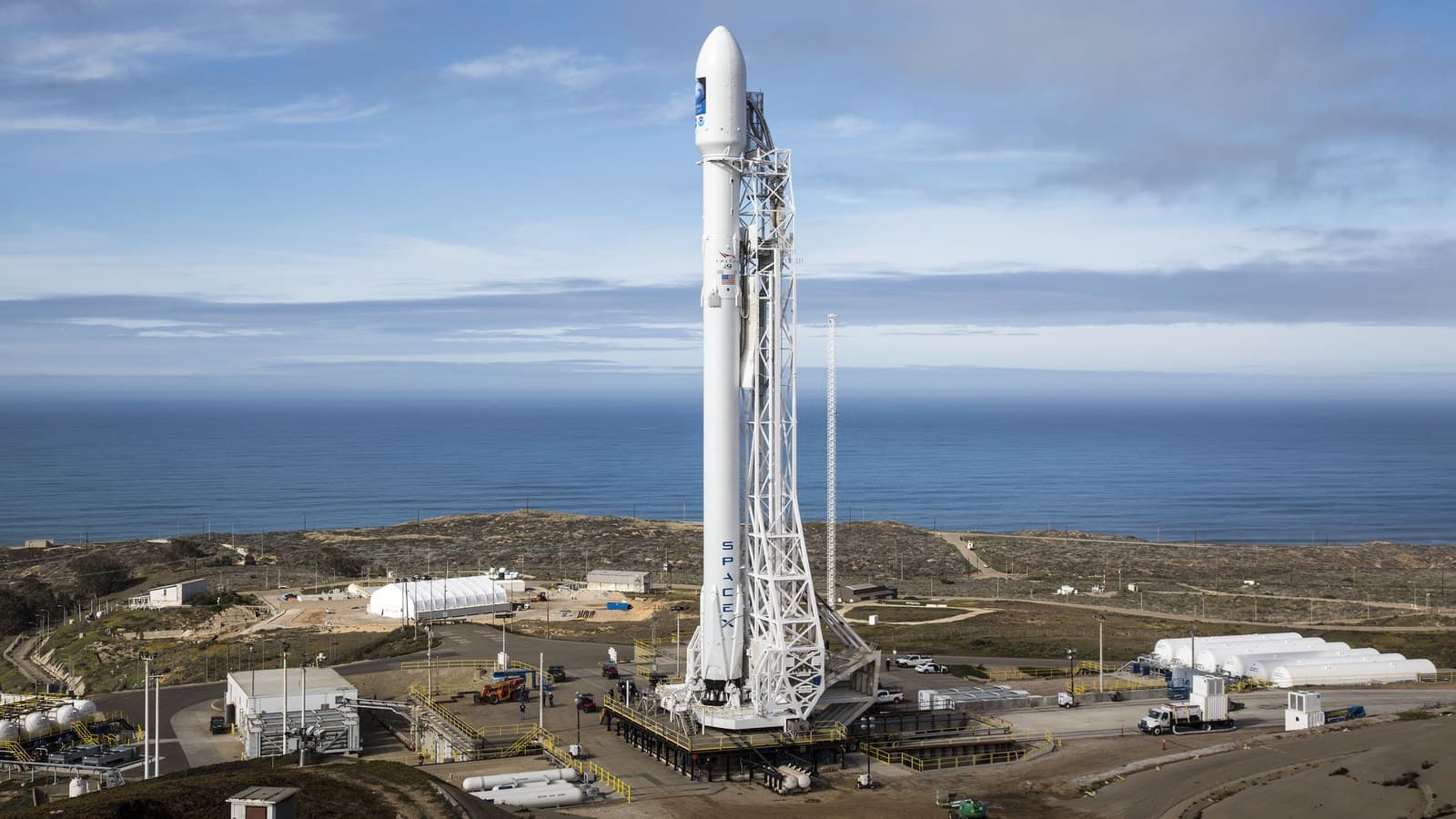
A Falcon 9 stands 70 meters (229 feet) tall and 3.7 meters in diameter. After separation the first stage is coasting upward and downrange at hypersonic speed, tumbling in near-vacuum. What follows is usually described as three burns, each with a distinct job.
- Boostback burn. Cold-gas nitrogen thrusters first flip the stage around, pointing the engine end in the direction of travel. Three of the nine Merlin engines then relight, canceling horizontal velocity and pushing the booster back toward the launch site. This burn is skipped on most drone-ship missions, where the ship travels downrange to meet the stage. On one early Orbcomm mission it lasted about 30 seconds and began around three minutes after launch, according to a NASA data sheet.
- Entry burn. Because the stage is returning from near-orbital velocity, the atmosphere becomes the enemy. The entry burn relights three engines for roughly 20 seconds, typically between about 70 and 40 kilometers of altitude, to slow the booster and wrap it in a protective cocoon of engine exhaust and shock. Without it, the stage would hit denser air too fast and too hot.
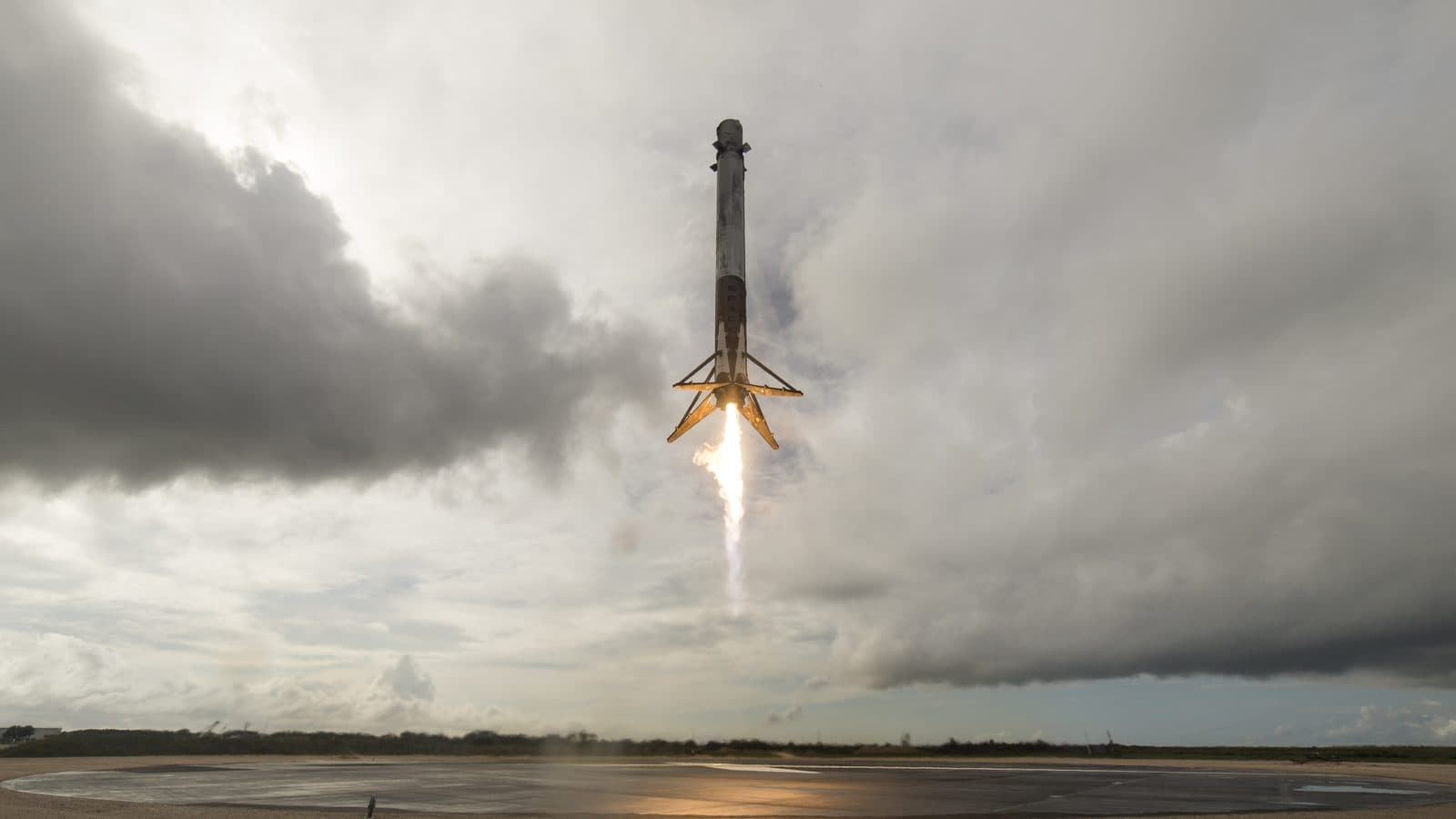
- Landing burn. The center engine alone relights in the final seconds, steering the stage onto its target and bleeding off the last of its speed. The legs deploy during this burn, not before, because deployed legs in fast air would be torn off.
The landing burn is a hoverslam, not a hover
A helicopter hovers because its engine can produce just enough thrust to match its weight. A Falcon 9 booster cannot. By the landing burn it is nearly empty and light, and even throttled all the way down a single Merlin 1D still pushes harder than the stage weighs.
The Merlin 1D produces about 845 kilonewtons (190,000 pounds-force) at sea level, and it can throttle down to roughly 40 percent of full thrust. An empty Falcon 9 first stage weighs on the order of 25 tonnes, or about 250 kilonewtons. At minimum throttle one engine still delivers more than 300 kilonewtons, so lighting it does not slow the stage to a stop and hold it there. It slows the stage, stops it, and starts pushing it back up.
The result is a maneuver engineers call a hoverslam, and pilots call a suicide burn. The engine lights at the last possible moment, and the flight computer times the burn so that velocity and altitude reach zero at the same instant. Light too early and the booster stops short, then falls back; too late and it hits the deck with engines still firing. There is no second attempt and no hover to correct a mistake; the margin lives in software that models the vehicle's mass, engine response, and the air it is falling through.
Steering through the fire: grid fins, thrusters and legs
Coming down is as much a steering problem as a braking problem: a booster that misses its target by a few hundred meters lands in the ocean instead of on a barge.
Four hypersonic grid fins, mounted near the top of the first stage just below the interstage, do most of the aerodynamic work. Each is roughly 1.5 by 1.2 meters and can rotate to redirect airflow, giving the stage pitch, roll, and yaw control through the atmosphere. Early Falcon 9s used aluminum fins with an ablative heat shield; several caught fire, so the Block 5 generation switched to cast-and-cut titanium fins that tolerate far higher temperatures and let the booster fly a higher angle of attack, which reduces the propellant needed to land.
Below the fins, small cold-gas thrusters running on nitrogen handle attitude control outside the atmosphere and assist when the air is too thin for fins to bite. At the bottom, four carbon-fiber landing legs with aluminum honeycomb cores deploy in the final moments and spread the load of touchdown. SpaceX's early description of the problem compared the stage to "a rubber broomstick on your hand in the middle of a wind storm."
Drone ship or back to the pad?
SpaceX recovers boosters in three ways: return to launch site (RTLS) on a concrete pad such as Landing Zone 1 at Cape Canaveral, a downrange landing on an autonomous spaceport drone ship, or disposal. The choice is a performance tradeoff.
Flying the booster back to the launch site consumes propellant that could otherwise go to the payload. It is the least expensive recovery option and gives the fastest access to the stage, but it reduces the mass the rocket can deliver to orbit. A drone ship sails several hundred kilometers downrange, so the booster needs no boostback and keeps more propellant, preserving capacity for heavier satellites and higher-energy orbits. The cost is time and weather: the stage must be towed back to port, and recovery can be delayed by rough seas.
SpaceX names its drone ships after vessels in Iain M. Banks's Culture novels: Of Course I Still Love You, Just Read the Instructions, and A Shortfall of Gravitas. In 2026 the company began moving one East Coast ship toward Starship support.
The economics of flying again
The reason all of this engineering exists is arithmetic. A standard Falcon 9 launch under a payment plan through 2026 is listed at $74 million for up to 5.5 tonnes to geostationary transfer orbit, up from $70 million in 2025 and $67 million in 2022. Reporting from Ars Technica has put SpaceX's internal cost for a reusable Falcon 9 flight at around $15 million, of which the upper stage is a large share because it is still expended on every mission.
The booster itself can fly many times. By the end of 2025 SpaceX had pushed a single Falcon 9 booster to 32 flights; by August 2026 a booster reached its 37th. A 2026 cost analysis concluded that post-landing inspection and refurbishment runs under $300,000 per cycle, though SpaceX has never published audited figures and outside estimates vary widely.
Two smaller savings matter too. The payload fairing, the clamshell nose cone that protects the satellite, costs about $6 million a set. SpaceX fits each half with a parachute, and recovery ships named Bob and Doug fish them from the sea or catch them in a net, avoiding several million dollars of composite on every flight.
Then there is demand. SpaceX's own Starlink constellation became the anchor customer that made high cadence possible. Of the record 165 Falcon 9 orbital launches SpaceX flew in 2025, 123 carried Starlink satellites. Flying a reusable rocket a few times a year cannot repay the investment; flying it more than 150 times a year can.
Why it was called impossible, and what changed
For years the industry view held that landing an orbital booster was not worth attempting, and the objections were real. A landing stage needs engines that restart and throttle deeply enough to control a descent, reserve propellant left when it arrives, guidance software fast enough to solve a nonlinear control problem in real time, and structures that survive reentry.
The turning point was not one invention but the combination of all of them, demonstrated in public and then iterated on. SpaceX failed repeatedly: boosters ran out of hydraulic fluid for the grid fins, throttle valves responded more slowly than expected, landing legs failed to lock, and stages punched holes in drone-ship decks. Each failure was diagnosed and flown again. In 2017 SpaceX president Gwynne Shotwell recalled science-fiction author Arthur C. Clarke's three stages of response to a revolutionary idea: first that it is impossible, then that it is possible but not worth doing, and finally that it was a good idea all along.
The commercial proof came on March 30, 2017, when SpaceX flew a previously used orbital-class booster for the first time, on the SES-10 mission. Recovery has been routine since. SpaceX passed 500 booster landings during 2025 and had recorded more than 650 by August 2026.
The competition: New Glenn, Neutron, China and Starship
SpaceX no longer has the field to itself.
Blue Origin landed its New Glenn booster on a drone ship called Jacklyn on the rocket's second flight, on November 13, 2025, while deploying NASA's ESCAPADE spacecraft. The roughly 189-foot booster uses seven BE-4 engines, and Blue Origin is certifying the vehicle with the U.S. Space Force.
Rocket Lab is developing Neutron, a reusable medium-lift rocket with a "Hungry Hippo" captive fairing that stays attached to the first stage and returns with it. Neutron is designed for return-to-launch-site landings and up to 13,000 kilograms to low Earth orbit. Its debut has slipped to early 2027.
China demonstrated two recovery methods within weeks of each other in 2026. On July 10 a Long March 10B first stage was recovered at sea using a net-capture system, and on August 19 LandSpace's Zhuque-3 Y2 became China's first orbital-class booster to land on the ground with deployable legs. Its first stage, powered by nine TQ-12A methane engines, is designed for at least 20 reuses.
Starship takes a different route. Rather than landing on legs, SpaceX's Super Heavy booster is caught in mid-air by the chopstick arms of its launch tower, a system SpaceX calls Mechazilla; the first catch came on October 13, 2024, during Starship's fifth flight test. SpaceX flew a previously used Super Heavy in May 2025, though that booster broke apart during its landing burn. Starship aims for full, rapid reuse of both stages, a step beyond Falcon 9, whose upper stage is still thrown away on every flight.
What to watch
The open questions are less about whether boosters can land than about how cheaply and how often.
- Refurbishment and turnaround. The 24-hour reflight goal SpaceX set years ago remains far from routine; inspection, recertification, and engine checks set the practical reuse rate.
- Certification for more flights. SpaceX has extended booster certification toward 40 flights, and each extension tests how structures and engines age.
- Full reuse. Starship's economics depend on catching and reflying both stages rather than the booster alone, a harder problem than Falcon solved.
- The international field. New Glenn's cadence, Neutron's first flight, and China's move from recovery tests to reflight will decide whether reusable launch becomes a competitive market or stays a SpaceX near-monopoly.
- The second stage. Until an upper stage is reused too, every launch still throws away a brand-new vehicle, the largest remaining cost in the stack.
The one-sentence version
A reusable booster works because a deeply throttleable engine, aerodynamic fins, and software precise enough to time the final burn to the second can bring back the most expensive part of the rocket, turning launch from a one-time purchase into something closer to an airline operation.
Tags
Frequently asked questions
- Why can't a Falcon 9 booster hover before landing?
- When the booster reaches its final burn it is nearly empty and very light, while even a single Merlin engine at minimum throttle produces more thrust than the stage weighs. The engine cannot hold a steady hover, so the burn has to be timed so that speed and height reach zero together.
- What are the three burns of a Falcon 9 landing?
- A boostback burn reverses the stage's horizontal velocity and aims it back toward the launch site, an entry burn slows it through the upper atmosphere to limit reentry heating, and a final single-engine landing burn brings it to zero velocity at touchdown.
- Why does SpaceX land boosters on drone ships instead of back at the launch pad?
- Returning to the launch site saves the travel time of a drone ship but burns extra propellant on the boostback, which reduces how much payload the rocket can carry. A drone ship waits downrange, so the booster keeps more fuel and can lift heavier satellites to higher orbits.
- How much of a rocket's cost is the first stage?
- Elon Musk has estimated the Falcon 9 first stage accounts for roughly 70 to 75 percent of the vehicle's cost, which is why reusing it matters far more than reusing any other part. The second stage is still expended on every Falcon 9 flight.

TPW Editorial
Editorial Team
TechPastWeek's editorial team reports and edits every story we publish. We research each piece against primary and credible secondary sources, and a human editor reviews and signs off before it goes live.