The US Confirms It Has Weapons in Orbit, Ending Decades of Ambiguity
Air Force Secretary Troy Meink confirmed the US has on-orbit space control weapons, the first public admission of deployed space weapons. Here's what it means.

On this page
Key takeaways
- Air Force Secretary Troy Meink confirmed on Sept. 14, 2026 that the US has deployed on-orbit space control weapons, the first public admission that American weapons are in Earth orbit.
- The Space Force says the systems can be used for offensive and defensive purposes and may be kinetic or non-kinetic; officials declined to describe the hardware, its numbers or its deployment date.
- The 1967 Outer Space Treaty bans nuclear weapons and other weapons of mass destruction in orbit, but it does not cover conventional orbital weapons or ground-based anti-satellite systems.
- China and Russia condemned the disclosure, and Moscow and Beijing are expected to press for a binding ban on weapons in space at the UN General Assembly.
- The admission ends decades of deliberate ambiguity; analysts warn that with no detail about the deployed systems, routine satellite manoeuvres could look threatening to rivals.
On Monday, September 14, at the Air & Space Forces Association's 2026 Air, Space & Cyber conference in National Harbor, Maryland, Air Force Secretary Troy Meink told the audience that the Space Force now has "on-orbit space control weapons capable of defending the joint force against hostile adversary action," as Air & Space Forces Magazine reported. It was the first time a serving US official publicly confirmed that the country has weapons in Earth's orbit.
Related reading: Google Is Sending Four TPUs to Orbit in Its First Suncatcher Test · Open Cosmos Raises €300 Million to Industrialize Europe's Satellite Supply.
Meink declined to say what the weapons are, how many exist, when they were deployed, or whether they are kinetic or non-kinetic. He said the wording was deliberate and "very well thought out," and at a press roundtable added: "I'm not going to talk about the specifics of what we're doing, whether we've tested or not tested or anything else," according to Defense News. "Me talking about the details would actually not benefit deterrence," he said, per Axios.
The official line, and why it was chosen
A Space Force spokesperson filled in some of the gaps. The capabilities "can be employed for offensive and defensive purposes at the direction of combatant commands," the spokesperson told ABC News, adding that the US has warned about Russian and Chinese weapons testing and operationalization since 2007. The same office told TechCrunch the weapons defend US forces "against space-enabled attack," a phrase that points to attacks on or through the satellites that carry navigation, communications and missile-warning signals. To The War Zone, a spokesperson offered a broader definition: "Space control encapsulates the mission areas required to contest and control the space domain, employing kinetic and non-kinetic means to affect adversary capabilities through disruption, degradation and even destruction, if necessary." The spokesperson said operations comply with international law, including the Outer Space Treaty.
The disclosure was not an accident. Officials described the phrasing as messaging meant to strengthen deterrence without revealing technical detail, and a Space Force statement called it the service's first acknowledgment that it had deployed weapons in orbit. The spokesperson also said that "open communication strengthens deterrence, prevents adversary miscalculation, and normalizes space operations alongside the other services."
Ending decades of ambiguity
Before this month, the US had acknowledged only ground-based electronic warfare systems among its anti-satellite capabilities, according to The War Zone, and in 2022 it announced a self-imposed moratorium on destructive direct-ascent anti-satellite tests. The Space Force's warfighting framework, published in 2025, describes interest in both kinetic and non-kinetic offensive systems, including "orbital strike" and "space link interdiction," as DefenseScoop reported. "Orbital strike" refers to actions that destroy, disrupt or degrade adversary space platforms, while "space link interdiction" uses electromagnetic or cyber effects to stop an adversary using its own satellites against US and allied forces. The vocabulary matters: it frames on-orbit weapons as one part of a single mission set that also includes defensive escort and counterattack, rather than as a standalone capability.
The context stretches back further. Gen. Stephen Whiting, who leads US Space Command, said in August that acquiring new anti-satellite weapons was a priority, and the competition with China and Russia has been building for years. In December 2025, President Trump signed Executive Order 14369, Ensuring American Space Superiority, which directs the government to ensure the ability to "detect, characterize, and counter threats to United States space interests" and which Air & Space Forces read as underlining the Space Force's role in the attack mission.
For decades, ambiguity itself had value: adversaries had to assume the worst, while Washington avoided the political cost of admitting it had put weapons in orbit. That posture is now gone, at least in public.
The treaty's gap
The 1967 Outer Space Treaty, which the US cites as the legal frame for these operations, bans nuclear weapons and other weapons of mass destruction in orbit. It says nothing about conventional weapons in space, and it does not cover ground-based anti-satellite weapons at all.
"There is a regulatory vacuum because Article 4 of the 1967 treaty only forbids weapons of mass destruction and nuclear weapons in orbit," space law expert Laetitia Cesari told AFP, in comments carried by CBS News. The treaty's second paragraph restricts weapons on the Moon and other celestial bodies rather than in Earth orbit, and its "peaceful purposes" language has long been read by spacefaring states to mean non-aggressive rather than non-military. Article IX's "due regard" and "harmful contamination" clauses create obligations, but they are general and hard to enforce against a specific payload.
Diplomacy has been stuck for years. Moscow and Beijing have pushed a treaty to prevent the placement of weapons in space for roughly two decades, while Western states have favoured voluntary norms of responsible behaviour. A UN Security Council resolution sponsored by the US and Japan that called on states not to deploy nuclear weapons or other weapons of mass destruction in space was vetoed by Russia in April 2024, and the split it exposed has not closed since. The disclosure "will likely give impetus to the restrictive approach that Moscow and Beijing are pushing for," Cesari said, and she noted the topic is likely to surface at UN disarmament talks in November.
What the weapons might be
"Space control" covers a wide range of systems, and the Pentagon left every option open. Non-kinetic tools can include radio jammers and lasers that dazzle or blind a satellite's optics. Kinetic options range from physical interceptors and grappling arms to spraying aerosols on sensors, or simply using one satellite as a projectile. The Space Force framework's "orbital strike" and "space link interdiction" categories map onto those two families, with interdiction described as exclusively non-kinetic.
Meink pointed separately to two missile-defense efforts under the Golden Dome shield: the Space-Based Interceptor program, which he said went from "initial contract to flight-ready hardware in less than one year," and the Space-Based Air-Moving Target Indication constellation, whose first satellites he said would launch this month. SpaceX won a $4.2 billion contract in May to start building the tracking constellation. Those systems are aimed at missiles rather than at satellites, but they sit in the same orbital environment and the same industrial base.
Debris, and the risk of escalation
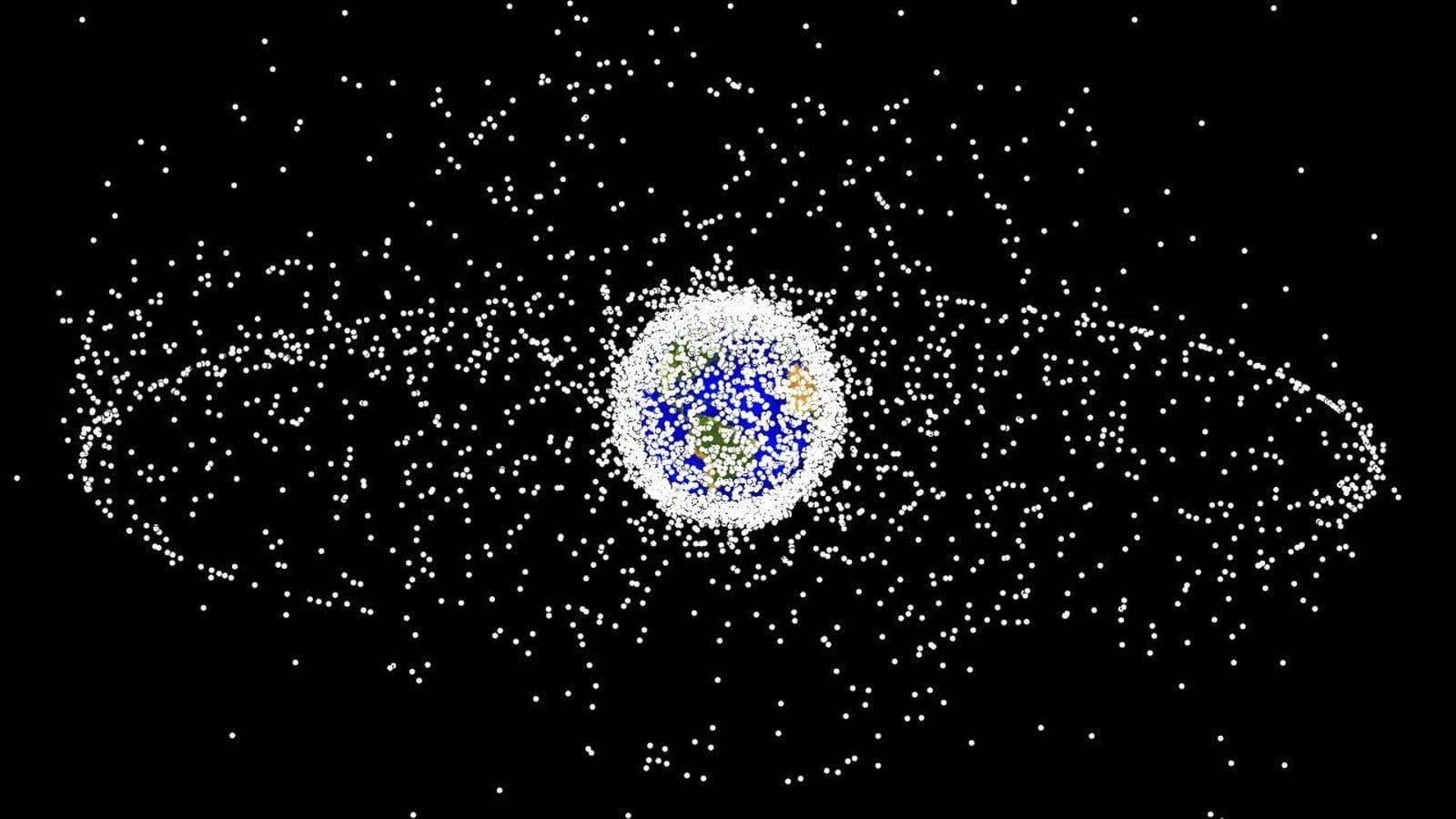
Kinetic attacks in orbit are treated cautiously for a reason. A destroyed satellite can shed thousands of trackable fragments moving at kilometres per second, and above roughly 600 kilometres those fragments can persist for centuries. China's 2007 anti-satellite test and Russia's 2021 test each created long-lived clouds, and the 2021 test prompted astronauts aboard the International Space Station to shelter. Roughly 700,000 pieces of debris larger than one centimetre are already estimated to be in orbit, and a collision at orbital speed can be catastrophic for an active spacecraft.
The US had long disavowed destroying satellites for exactly that reason, The New York Times reported. Non-kinetic effects avoid debris but are not harmless: jamming GPS or communications would ripple into civilian systems, because satellite timing underpins financial networks, power grids and transport. None of this establishes that the deployed weapons are kinetic, that any have been tested destructively, or that they have been used.
Russia and China respond
China's foreign ministry spokesperson Guo Jiakun urged Washington to stop expanding its military build-up in outer space, saying Beijing opposes weaponizing space or turning it into a battlefield, Xinhua reported. State-backed Global Times said the disclosure exposed a pursuit of "space hegemony" and risked fuelling a global arms race, per Reuters.
Russia was blunter. Kremlin spokesman Dmitry Peskov called for space to be kept "free of any weapons," and Foreign Ministry spokeswoman Maria Zakharova said Washington was ready to ignore "the catastrophic consequences for humanity of any armed conflict in orbit," Reuters reported. Deputy Foreign Minister Sergei Ryabkov said there was still time for a legally binding treaty banning strike weapons in orbit, and Foreign Minister Sergey Lavrov said Russia would press a UN resolution to ban any weapons in orbit, TASS reported. Moscow is due to bring resolutions to the UN General Assembly next month.
The disclosure landed days after US Space Command said it had completed Apollo Maneuvers 2026, its first live-fly exercise rehearsing coordinated spacecraft manoeuvres across low, medium and geosynchronous orbits, with allied and commercial partners. The command did not describe it as a weapons exercise, but it reflects the same shift toward satellites that move, evade and reposition under threat.
What to watch
Three things will show whether the admission changes behaviour. The first is verification. Without any detail about the deployed systems, other governments cannot assess what has actually changed, and analysts warn that ambiguity can make routine satellite manoeuvres look threatening, encouraging rivals to track or target a wider range of US satellites.
The second is arms control. Russia and China will use the admission to argue for a binding ban on weapons in orbit at the UN General Assembly, a proposal Washington has long resisted in favour of voluntary norms. Whether the US engages now, or doubles down on ambiguity, will shape the next round.
The third is whether the ambiguity holds. Lt. Gen. Greg Gagnon, who heads the Space Force command that trains operators for these systems, said this week that "as much as you want to know, Beijing wants to know even more," Bloomberg reported. Given that the first acknowledgment took decades, more disclosure now looks likelier than less.
Tags
Frequently asked questions
- Does the US have weapons in space?
- Yes. Air Force Secretary Troy Meink confirmed on Sept. 14, 2026 that the Space Force has deployed on-orbit space control weapons capable of offensive and defensive use. Officials did not say what the weapons are, how many exist or when they were deployed.
- Are space weapons banned by the Outer Space Treaty?
- No. The 1967 Outer Space Treaty bans nuclear weapons and other weapons of mass destruction in orbit and restricts weapons on the Moon and other celestial bodies, but it does not ban conventional weapons in Earth orbit or ground-based anti-satellite weapons.
- Is this the first time the US has admitted putting weapons in orbit?
- Yes. Before Meink's remarks the US had publicly acknowledged only ground-based electronic warfare among its anti-satellite capabilities, although its 2025 Space Force warfighting framework described interest in kinetic and non-kinetic orbital systems.

TPW Editorial
Editorial Team
TechPastWeek's editorial team reports and edits every story we publish. We research each piece against primary and credible secondary sources, and a human editor reviews and signs off before it goes live.