Yara Opens Europe's Largest Carbon Capture Facility at Sluiskil
Yara inaugurated Europe's largest industrial carbon capture plant at Sluiskil on Sept. 7, shipping up to 800,000 tonnes of CO2 a year to Norway for burial.

On this page
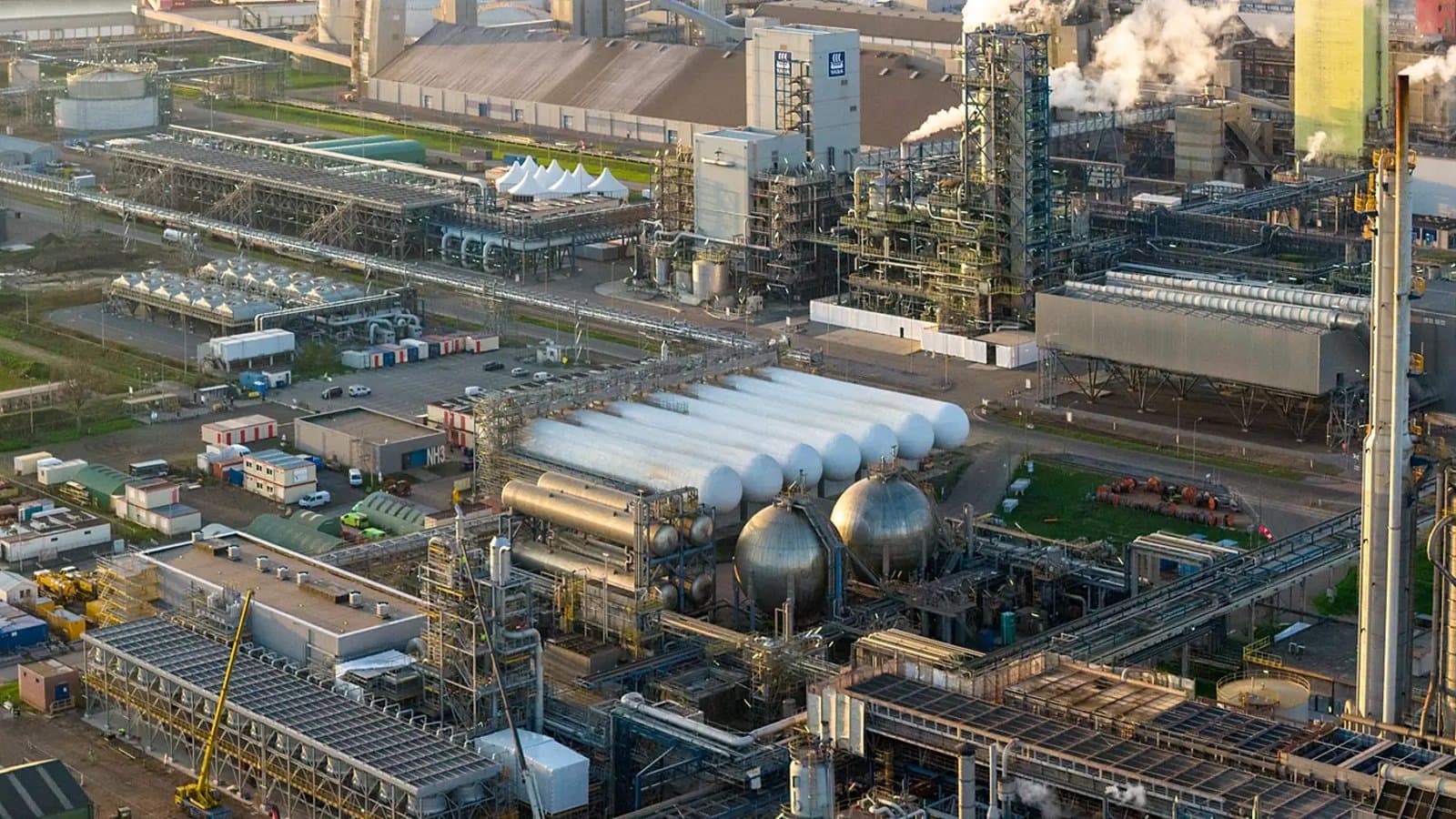
On September 7, 2026, Yara International formally inaugurated a carbon capture and storage facility at its ammonia and fertiliser plant in Sluiskil, in the Dutch province of Zeeland. The company calls it Europe's largest industrial carbon capture project, and the EU's energy directorate describes it as the continent's largest commercial CCS project. More importantly for the industry, Yara says it is the first complete cross-border chain: CO₂ is captured in the Netherlands, liquefied on site, shipped to Norway and injected permanently beneath the North Sea floor.
Related reading: Holcim Will Test Firebrick Heat Batteries to Clean Up Cement · Tesla Unveils a Flying Roadster 2 in Texas, With Production Set for 2028.
The ceremony drew Norwegian Prime Minister Jonas Gahr Støre, Dutch Prime Minister Rob Jetten, European Commissioner for Climate, Net Zero and Clean Growth Wopke Hoekstra, and Yara president and chief executive Svein Tore Holsether. The facility can capture and liquefy up to 800,000 tonnes of CO₂ a year from ammonia production, which Yara says avoids carbon taxation on those volumes. Over 15 years the company expects to capture and store around 12 million tonnes. "The carbon capture facility in Sluiskil proves that large-scale industrial decarbonization is possible today," Holsether said in Yara's announcement. "As global competition intensifies, Europe must find ways to cut emissions while keeping industry, jobs and critical value chains in Europe."
What the facility actually does
The project is less a single plant than a sequence of industrial steps, each of which has to work for the chain to deliver.
- Yara's ammonia production relies on steam methane reforming, which emits a high-purity stream of CO₂. The plant captures that process gas using MDEA absorption, then compresses and liquefies it at a rate of 125 tonnes per hour, according to Yara's project factsheet.
- The liquid CO₂ is held in seven on-site tanks with a combined capacity of 15,000 tonnes. Twice a week, a ship operated by Northern Lights collects a cargo.
- The vessel carries the CO₂ to Øygarden, on Norway's western coast, where Northern Lights runs an onshore receiving terminal. From there it travels by pipeline to a reservoir 2,600 metres below the seabed for permanent storage.
- The Sluiskil plant is Yara's flagship ammonia and fertiliser site, and the company says it is Europe's largest. The captured CO₂ supports lower-carbon fertiliser, low-carbon ammonia for industry and clean energy, and low-carbon fuels for shipping.
Yara's own factsheet makes the limits of the project explicit: the capture targets the high-purity process gas from ammonia manufacture, not every emission on the site. That is exactly what makes it a comparatively cheap place to start capturing carbon.
The project is a retrofit, not a new plant. Sluiskil has been trimming emissions for decades: since 1990 it has cut 3.4 million tonnes of CO₂ equivalent a year from ammonia and fertiliser production while nearly doubling output, according to Yara. Group-wide, the company says its scope 1 and 2 emissions are down 55% in the EU since 2005 and 45% globally. Ammonia producers are also already comfortable handling CO₂: European plants capture and liquefy it today for products ranging from sparkling drinks and greenhouse enrichment to AdBlue for diesel vehicles. CCS, in other words, is being bolted onto an industry that knows the molecule.
The chain in numbers
Up to 800,000 tonnes of CO₂ captured a year. 125 tonnes liquefied per hour. Seven storage tanks holding 15,000 tonnes on site. Two ships loaded each week, 7,200 tonnes apiece. A 15-year agreement covering roughly 12 million tonnes. Storage 2,600 metres beneath the North Sea. The captured volume is equivalent to around 0.5% of the Netherlands' total annual emissions, measured against 2022 levels.
Why ammonia is the test case
Carbon capture has always looked most credible where a waste stream is already concentrated. Ammonia production is one of those cases: the CO₂ leaving a steam methane reformer is nearly pure, so separating it costs far less than scrubbing dilute flue gas from a cement kiln or a gas-fired power station. That is why it sits at the cheap end of the capture market, and why as DW notes, experts tend to reserve the technology for genuinely hard-to-abate industry rather than treating it as a universal fix.
That economics matters because hard-to-abate industries have few alternatives. Yara cannot easily switch Sluiskil to a different feedstock at scale, and the nitrogen it sells is essential to global food production. Capturing the process CO₂ while leaving the ammonia line running is a way to cut emissions without shutting down capacity. It is also, in Europe, a financial decision: the EU Emissions Trading System forces large emitters to buy allowances for the CO₂ they release, and every tonne captured at Sluiskil is a tonne not paid for.
Yara signed the first commercial transport-and-storage agreement with Northern Lights back in 2022, and the binding contract followed in November 2023, the same month the company took the final investment decision. Yara has said the expansion of its CO₂ liquefaction capacity to handle 12 million tonnes over 15 years carried an estimated capital cost of about €200 million.
"This is an important day for Yara and for European industry. The carbon capture facility in Sluiskil proves that large-scale industrial decarbonization is possible today." — Svein Tore Holsether, CEO of Yara International
The shared infrastructure behind it
Yara did not have to build the storage side itself, and that is the model Europe is betting on. Northern Lights is a joint venture owned equally by Equinor, Shell and TotalEnergies, and it sells transport and storage as a service rather than tying storage to any one emitter.
Northern Lights' first phase, part of Norway's Longship CCS programme, has capacity to store up to 1.5 million tonnes of CO₂ a year, according to the company. Operations began in 2025 with CO₂ from Heidelberg Materials' cement plant at Brevik, Norway, the first volumes to be injected. Yara signed the first commercial agreement and the first cross-border one. TotalEnergies lists Heidelberg Materials, Celsio, Yara and Ørsted among its customers.
The Norwegian government has covered the bulk of the cost of that first phase, and the EU has supported the build-out through its Connecting Europe Facility. The European Commission describes the Sluiskil project as a direct result of the EU–Norway Green Alliance signed in 2023, and the Northern Lights storage site as CEF-funded. A second phase, approved in March 2025 at a cost of NOK 7.5 billion with a €131 million EU grant, is meant to lift capacity to at least 5 million tonnes a year by the second half of 2028.
The cross-border design is the point. Storage geology is not distributed evenly: Norway has deep saline aquifers under the North Sea and a state willing to underwrite the early risk, while the Netherlands has dense industry and limited local storage. Shipping the CO₂ lets each country specialise and lets one receiving hub serve many emitters instead of every plant building its own reservoir. That shared-infrastructure model, rather than any single capture technology, is what the EU hopes to replicate across industrial clusters.
The hard part is scale, not chemistry
Northern Lights managing director Tim Heijn called the opening a milestone. "Together, we are demonstrating that capture and cross-border CO₂ transport and storage is a viable solution for European industry," he said. The technology itself is not really in doubt. "It's ready to go, technologically. We know how to do this process," Susan Hovorka, a geoscientist at the University of Texas at Austin, told DW. What is missing is commercial experience at scale.
The numbers in that DW analysis are sobering. The United Nations' climate science body has sketched scenarios requiring somewhere between 350 and 1,200 gigatonnes of CO₂ storage this century. A single Sluiskil-size plant captures 0.8 million tonnes a year; meeting even the bottom of that range would take thousands of comparable facilities. The International Energy Agency has projected 7.6 gigatonnes captured annually by 2050, against the roughly 64 million tonnes the world's operating plants can manage today. "The scale of what's being called for in those scenarios is astronomically beyond any real activity that exists today," said Danny Cullenward of the University of Pennsylvania's Kleinman Center for Energy Policy.
There is also a debate about what CCS is for. In 2023, about 80% of the world's CCS capacity was used for enhanced oil recovery, where injected CO₂ helps push more oil out of the ground, according to the research and advocacy group Oil Change International, a use that increases emissions overall. Some researchers argue that a reliance on capture creates a moral hazard, giving fossil-fuel assets an excuse to keep operating. The counter-argument, and the one this project leans on, is that capture belongs in genuinely hard-to-abate industry where production cannot simply be electrified.
Even the geology has limits. DW cited research suggesting the Earth's practical CO₂ storage capacity may be closer to 1,460 gigatonnes than the 10,000–40,000 gigatonnes of earlier estimates, which would mean that most CCS-heavy climate scenarios exhaust available storage within a couple of centuries. Sluiskil's reservoir, in the North Sea, is monitored and permitted, but the long-term liability of keeping CO₂ underground for geological time is one that no single project can resolve on its own.
Yara's caveats are its own. The facility has only just started operating, so the realised capture rate over a full year is unproven. Its economics depend on the EU carbon price and on policy remaining stable through 2040, the far end of the 15-year agreement. The transport leg adds shipping emissions and depends on vessel availability and port capacity. And storage is a long-term liability that requires monitoring for decades after injection stops.
What to watch
Four signals will show whether Sluiskil is a template or a one-off. The first is whether Yara hits its 800,000-tonne annual figure, and publishes verified capture data rather than design capacity. The second is whether other European emitters follow: Northern Lights says it is in advanced talks with several more industrial customers, and its Phase 2 capacity will need them. The third is policy. The EU's Emissions Trading System and its proposed review are the main reason capture pays at all; a weaker carbon price would strand the economics. The fourth is cost, which will determine whether cross-border storage becomes a service many industries can afford or a subsidy-dependent niche.
The broader test is whether the model Europe is assembling (a shared offshore sink, a carbon price, and state-backed first-of-a-kind risk) can be replicated at the pace the climate scenarios demand. Sluiskil proves the chain can be built. It does not yet prove it can be built thousands of times over, at a price that makes the arithmetic work without public money.
Tags

TPW Editorial
Editorial Team
TechPastWeek's editorial team reports and edits every story we publish. We research each piece against primary and credible secondary sources, and a human editor reviews and signs off before it goes live.